How to Interpret Houses in Astrology – Part 5: The Fourth House

Where do we come from, and when all is said and done, where is it that we shall return? What is the source and summit of our sojourn through life? What is our center of gravity?

These weighty matters are the purview of the fourth house in astrology.

But before we get too far into the weeds, it’s time for a useless piece of information that I find delicious.

そっこんは、日本語をならいます.(I’m learning Japanese right now). In numerous east Asian cultures, Japan included, the number four is associated with death, partly because the number four (四, pronounced shi in Japanese, except when it’s pronounced yon) sounds like the word for die (死, also pronounced shi). Considering where we’re about to go with the meaning of the fourth house, you might want to keep this in your back pocket.

Unlike the third house, which derives its meanings from the planet that joys therein (namely the Moon), the fourth house in astrology derives its meaning from its astronomical features. No planet joys in an angle, save Mercury in the first, who strides across the realms of death and life with fleet feet, bridging the matter and spirit as a psychopomp.

The other three angular houses derive their meanings from the way in which planets encounter turns in their diurnal courses there. Remember that these angles are, to the ancient mind, the four stakes upon which the world is founded.

In quadrant-based house systems, the fourth house is centered around the lowest possible point in relation to the Zodiac, called the imum coeli, literally “the bottom of the sky.” This point marks the cusp of the fourth house. In sign-based systems, the fourth sign counter-clockwise from the ascendant fulfills this role.

This point is as far below the earth a planet can descend before it begins to ascend once more. If you’re standing in the middle latitudes of the northern hemisphere and facing south (i.e., facing the midheaven), the imum coeli, is under your feet and behind you a little. In middle and tropical latitudes, this point generally falls within the fourth sign from the ascendant as well.

The IC is as far out of your field of vision as it can possibly be. Planets at this point are hidden deep within the earth, but because they take their position at one of the celestial stakes, planets placed here have a subtly stunning impact on the unfolding of the narratives promised by a chart.

This point is a turning point. The transition that occurs here is one that is subtle, invisible to mortals on the surface, known only to those who understand that an uncanny transition from death to life begins at this point.

It’s worth noting that the Latin term “medium coeli,” which refers to this point’s opposite point in the visible sky, is not, as you might expect, called “cacumen coeli” or “apex coeli,” either of those meaning “top” or “highest point” of heaven. The ancients understood the place where planets reach their heights as primarily the middle of the sky, where planets were at their most visible and influential (beside the ascendant).

The base of heaven, then, is not just the lowest point—it is also the terminal point where the journey of a planet around the sky according to the diurnal march of the heavens around the celestial sphere end their journey and begin a new one. In this sense, the IC and the fourth house form the alpha and omega point, the beginning and the end.

The mythic power of the fourth house is floating right on the top of this soup of symbolism.

Dane Rudhyar, the 20th century astrologer and composer, evocatively described the fourth house as “the center of the globe,” that is, the center of gravity. Our center of gravity. The point draws our attention to the planet on which we stand, its gravity, its cycles, the raw material from which our experience emerges and unto which we will return. “Ashes to ashes.”

The fourth house symbolizes our center of gravity and everything upon which our experience of this lifetime stands; it is our point of deepest sustenance. Bernadette Brady, a British astrologer, describes planets and stars tied to the imum coeli as related to our “foundations,” fixtures that ground us and root our entire experience.

Because of its location, the meanings of the fourth house are shot through with the myths of the underworld. When I say “underworld” here, I don’t mean the fire-and-brimstone realm that is the darling of so many fundamentalist Christians. In fact, this version of “hell” is largely a medieval rhetorical invention that borrowed heavily on the description of a place called Tartarus which Vergil’s Aeneid described and which Dante Alighieri and those who followed in his footsteps so colorfully and horrendously describe in art and verse. What I mean, rather, is Hades, what the Hebrews called Sheol.

The early Christian conception of the underworld was much more in line with the Jewish view they inherited, itself influenced in large part the Greek understanding of Hades which was in the drinking water of the Mediterranean basin in the first century CE. In this view, the underworld is not a place of conscious torment, but rather a prison, a gravitational well.

That which laid in the grave was inert: “the grave cannot praise thee, Death cannot celebrate thee,” sang the psalmist. However, in the Easter mythos, the underworld is emptied of its dead as all its inhabitants are raised to new life at the resurrection of Christ, the great turning of the world—which unfolds at the cosmic imum coeli, the point where death pivots into life.

This myth has a similar flavor to other dying-and-rising myths found around the Mediterranean basin during astrology’s heyday. Because so many stories from around the world have subterranean dying-and-rising baked in, there’s a thread to pull here.

I’d go so far as to conjecture that every human narrative has some form of dying-and-rising experience. In that sense, the fourth house serves as the setting for the unfolding of that turn in our personal mythology. Keep in mind that the fourth house and the eighth house, which describes death, are configured to one another by a trine.

It is at the imum coeli that the roots of the world tree run their deepest; it is at the imum coeli that the waters under the earth gather as they flow from cloud to spring to mountain to ocean. It is in the bowels of the underworld that death is changed to life as all life flows there through its course. That which returns to the grave is transformed into the raw material of new life. The cosmic cycle begins anew.

The Astrological Meaning of the Fourth House

Ultimately, the fourth house in astrology describes the places we come from, and the place that we will return at the end of it all. It’s our source, our summit, our center of gravity. And for that reason, the fourth house picked up three primary significations:

The first is our roots, specifically our parents and the legacy that we inherited from them (and that we inherit from the living in general). Our parents are the closest humans to us, and we emerged from them, as humans emerged from the Earth (figuratively). The peculiar relationships we have with our parents are described by the nature and condition of planets involved with the fourth house, whether the house’s ruler or any planets placed therein.

The second is our home, both in the sense of the place that comes to mind when we think of “home” but also our daily dwelling place—so, our actual house or apartment. That’s because the home is our daily center of gravity; it’s where we depart in the morning to attend to our daily activities, it’s where we return to sleep in the evening, and it serves as the center of gravity around which our day-to-day activities revolve.

The third is the land, for all the reasons I cited above. We gain our sustenance from the land, our bodies transform material that is drawn out of the earth into our embodied life, and upon our death, we return to the land. Because of the connection to the land, we can also see how any matter related to the land is signified by the fourth house: material resources, real estate, speculative assets.

Sidebar: in horary astrology, there’s one additional signification that gets thrown around when the fourth house is highlighted in a chart. That signification is the “end of the matter.” Often folks want to go here to determine what the final outcome of a question is, but that’s not quite what this Jacobean turn of phrase means. Rather, this phrase signifies the legacy that a question will leave for the person who asks it, and the ripple effects that a given course of action will have for those who come after them.

How to interpret the fourth house in astrology

Given the three major significations I laid out, we’ll be looking at three primary questions when it comes to dealing with the matters of the fourth house:

  • What is this person’s relationship to their parents and ancestors, and what will they pass on to those who come after them? In other words, what psychic baggage did they inherit from their parents, and how will they adapt, transform, and heal that psychic baggage to hand it on to those who come after them?
  • What its this person’s relationship to home? Where is their center of gravity? Are they fixed in one place, or do they have a fire under their tail that drives them from one place to another? Are they given to settling or constant motion?
  • What is this person’s relationship with the land itself? Do they feel a connection to the land on which they walk, or do they travel through their unique geography as a sojourner?

Remember that the ruler of a house expresses its purposes among the affairs of the house that it is placed in and in accordance with the style and priorities of the sign in which it falls. How well or poorly a planet can do its job depends on its condition. (Do I sound like a broken record on this point yet?)

Meanwhile, planets placed in the fourth house have a direct impact on a person’s relationship to those three areas spelled out above.

Let’s look at an example. Say that a native has Virgo rising, with their IC falling in Sagittarius in the fourth sign (keeping it easy here). In this case, their fourth house ruler is Jupiter. Suppose their natal Jupiter is in Virgo, right in the first house. This suggests that their connection to their parents is deeply influential to them, sitting right on the steering wheel of their chart. This ensures that they live up to the expansively scrutinizing standards of their parents becomes a major theme throughout their life, and something which they as a parent will pass on to their children.

Likewise their relationship to their physical house and dwelling place is of the nature of Jupiter in Virgo: they have a deep, abiding desire to have a house to call home but it may be that other factors in their life, possibly their marriage partner’s job (since Jupiter is also the 7th ruler, as well as the turned 10th ruler) prevents them from being able to own a home and put down roots in the way that they would truly prefer. Finding a place to settle down will require a herculean effort and it’s likely that having to pack up and move every so often will simply be part of their life narrative. When it comes to maintaining their home, only perfection suffices: they have an overblown standard of cleanliness, and heaven forfend anyone leave their crap laying around.

The ruler of the fourth house through the houses

  • Fourth house ruler in the first house: your parent’s desires and expectations, your relationship to your dwelling place, and your level of engagement with the land all have an unyielding influence on your personality and your attempts to create the best circumstances for yourself. It might be difficult for you to differentiate from your parents if your fourth ruler is afflicted, but if it’s in good condition, this may suggest that you enjoyed a wonderfully supportive upbringing that has carried you into adulthood.
  • Fourth house ruler in the second house: your relationship to parents, home, and the land is as a resource to you that you can access to support overall outcomes in your life. If this planet is well-placed it can indicate that you’ve got access to estate; if poorly-placed, home can become a money pit.
  • Fourth house ruler in the third house: you’ve likely never strayed far from home, and your old stomping grounds are probably still your current stomping grounds. You find a sense of family identity especially among your siblings and lateral contemporaries.
  • Fourth house ruler in the fourth house: you’ve got roots that run deep and you know precisely who you are and where you came from. You don’t need the Disney musical to tell you who you are, and carrying on that legacy to the next generation is a major part of your sense of identity and purpose.
  • Fourth house ruler in the fifth house: home is a source of fun and creative drive for you. Your relationship you’re your parents was likely pleasant and supportive, depending on how well the planet that rules the fourth is doing here.
  • Fourth house ruler in the sixth house: home, family, and the land are areas where you feel a certain sense of drudgery and responsibility. This may manifest as being asked to return home to care for an ailing parent when your fourth ruler is activated by timing techniques, or it may signify that you work within the family business.
  • Fourth house ruler in the seventh house: your sense of home and center of gravity is tied up in forward motion and it’s very unlikely that you’re one to stay in a single place for a long time. One of the reasons for this is that, in relocation horary questions, the 4th house is “stay” and the 7th house is “go.” This could also mean that you are more likely to follow your partner’s career and call wherever they land “home,” because for you, there’s a good chance that “home” is where your partner is if this is the case. (This is my 4th ruler placement, by the way.)
  • Fourth house ruler in the eighth house: you have a strong sense of what it is that you inherited from your family, and it is a present possibility that there is some element of fear or loss connected to the story of your upbringing. Interpreting that story in life-giving ways then becomes part of your own dying-and-rising myth.
  • Fourth house ruler in the ninth house: home is far away, either far away from where you grew up or far away from where you are now. The land you tread serves as a teacher and a spiritual nexus for you as well.
  • Fourth house ruler in the tenth house: your family and land story plays out in the actions you take for which you are most remembered, whether within the context of your career or the ways in which the legacy you inherited from your parents drives your public actions.
  • Fourth house ruler in the eleventh house: home and lineage is a source of good fortune for you, and you find yourself among friends when people know who your parents were (or among enemies, if the fourth ruler is afflicted here). Pay attention to the way that stories from your upbringing play out anew among your friends, groups, and chosen family.
  • Fourth house ruler in the twelfth house: distance. Distance between you and your roots, you and your parents, you and the land on which you tread. Bridging that gap of isolation requires long, thoughtful, considered effort, and can be wildly fruitful if the condition of the planet so promises. The other niche interpretation is a strong connection to livestock and animal husbandry, but that’s going to be fairly unusual.
  • Where’s your fourth house ruler? What’s its condition? How do you see the story of your fourth house playing out in the overall arc of your story? Let me know in the comments!

    Featured image by Jared Rice via Unsplash

How to Interpret Houses in Astrology — Part 4: The Third House

Admittedly, my posture towards the third house has been one of, “…well, we can get to that later.”

On the surface, it’s such a grab-bag of significations throughout the astrological tradition that doesn’t lend itself well to focused interpretation in the way that, say, the second house does with money matters, or the tenth house does with career.

It never feels certain which direction to go when interpreting third house matters in the situation that a person presents you with in a nativity or in a horary question. Whenever we come to this part of the chart I have to take a beat and figure out how to use words again, because they often fail me.

Are we looking at siblings? Family? Paperwork? A short trip? What if the person doesn’t have siblings? What do we do with the third house then? Or if a concern is about a communication between a person and their relatives: what’s the issue with the third house here—is it communication, or is it relatives?

But in preparing this article I’ve come to a deeper understanding of what the third house is actually about, and if we break it away from the “third house equals Gemini equals communication” model that is prevalent in most of the beginner astrology books out there, it takes on a particular richness that is easily missed if one stays purely at the surface level.

Then again, that’s to be expected from a house that is cadent and under the earth: it’s easy to overlook.

The starting point for understanding the meaning of the third house is this: this house is known as “the joy of the Moon.” In the classical astrological tradition the joys of the planets were particular parts of the sky where it was understood that each planet “rejoices” to be in.

For example, Sun rejoices to be in the ninth house because when the Sun moves through the ninth house during the day his heat and brilliance are at their maximums. Mercury rejoices to be in the first house because it is the bridge between the realms of the invisible and the visible, the mundane and the sacred, the alembic in which the deep alchemy of life manifests its elixir.

For the Moon, this is the third house—the house which opposes the Sun’s joy in the ninth. If we break apart the tradition to look at how the third house sausage is made, we see quickly how the signification of a planet being “in its joy” imported that planet’s meanings into the house where it rejoices.

So, let’s start talking about the third house by not talking about the third house at all; let’s start with the Moon instead.

What then, is the Moon?

Deborah Houlding includes a compelling discussion on this subject in her book, Houses: Temples of the Sky (affiliate link) that I think bears drawing out here for sure. She describes the nature of tribal and community experiences in the ancient world as being deeply tied to the cycles of the moon, a facet of life together that most Westerners have lost touch with.

But consider: for the major world religions, the lunar cycle is one of the most important calendrical features, working in concert with the Sun to describe shared communal experiences of fasting and feasting. The dates of the Islamic month of Ramadan, the Jewish feast of Passover, and the Christian celebration of Pascha/Easter are all determined in large part by the Moon. And it is during these fasts and feasts that we see much more emphasis being placed on community togetherness and tribal celebration.

In my own tradition it’s something of a joke that Easter is the best-attended Sunday of the liturgical calendar. But if we take a step back to consider this from an astrological perspective, it’s almost as though this phenomenon is a literal manifestation of the symbolism here. This feast is carved into the wheel of the year by the Moon herself bringing people together as a tribe to celebrate an important component of tribal identity. The same is true of similar lunar feasts in other traditions. While this is an anomaly to the contemporary Westerner, in the ancient world these cycles of the Moon were part and parcel of living in communities with one another as individuals whose survival depended on maintaining tribal cohesion and identity.

We see that one of the first functions of the Moon is to gather and unite in a community what Deborah Houlding describes as “lateral contemporaries.” In the ancient world, your immediate lateral contemporaries were your siblings and relatives. They served as your peers, your colleagues, your coworkers, and the social medium in which you grew up and came to understand the world.

The second major function of the moon is to transfer, translate, and transmit: the prefix “trans-“ in all of these words suggests crossing lines to facilitate communication between parties who have no other means of talking to one another. Another application of this principle is the fact that the Moon, throughout traditional astrological literature, is viewed as “the transmitter of celestial influences,” with Guido Bonatti going so far as to call the Moon a “mediatrix”—a title Catholics know as one of the epithets of the Virgin Mary, who very quickly got packaged in lunar symbolism as Christianity expanded through the Middle East and into eastern Europe.

The reason for the moon’s status as celestial go-between is twofold: one, the Moon is changeable, adaptable, and fast as hell compared to the other seven visible planets, taking only 28 days to make it around the wheel of the zodiac once compared to the average year that it takes the next fastest planet, Mercury. She can get around. As she does, she picks up the influence of the planets she aspects and transfers that influence to everything else she encounters. She also serves as the intermediary between the realms of heaven and earth, and any celestial influence must get through her. Her carrying and gathering nature, combined with her immediacy, changeability, and direct visibility make her a fabulous medium.

The Moon as one of the natural significators of communication and the mind is one of the planets that we look at to describe a person’s ability to intuit information. In Egyptian mythology, the ibis-headed deity Thoth was associated not with the planet Mercury, but the Moon, and Thoth himself was regarded as the god of writing, magic, and wisdom. In like manner, the Moon performs these roles exceptionally; we often see the Moon placed well in the charts of individuals who are notable writers or communicators.

I’ll go off-script to note here that, yes, Mercury is associated with the mind as well, but primarily with the rational, thinking functions of the mind that discern, label, and assemble information into cognitive constructs. The Moon functions differently, instead representing the gathering and dissemination of information itself, often by force of intuition.

With all of this in mind, I want to suggest that the basic signification of the third house is “medium.”

Not “medium” as in the size, or a bleach-blonde woman from Long Island, but rather “medium” as in the field that facilitates communication, exchange of knowledge, and shared tribal experience. That is, what is meant by the word “media” in “social media.” For example: Twitter is a social medium.

Think of the average person in the ancient world: they lived a tribal existence, found their identity as part of a communal experience governed by the cycles of fasting and feasting dictated by the Moon, and were educated in such a way as to maintain tribal cohesion. The main people with whom they exchanged words, ideas, and concepts were their peers, namely their siblings, cousins, and neighbors (who were often one and the same).

We can see now how the third house has accreted this peculiar cluster of significations, then: as the Moon rejoices to be here, so matters of the third house take on her priorities. She travels quickly, gathering people into a community as she does so, using words, concepts, and daily activities to stir us into a shared experience. As she whips around the Earth she causes the ebb and flow of water across the planet, that medium without which no life as we know it can exist. All the while, she serves as a mediatrix between the immense and unknowable wisdom of the cosmos and the blessedly mundane situations we encounter in our day to day lives.

Now, let’s land the plane.

How to interpret the third house

Interpreting houses in astrology effectively is a matter of asking the right questions at the right time. Just as we asked, “who is driving the boat, where are they steering it to, and how good of a job can they do?” with the first house, we asked “where is the golden vein, and how easy is it to access?” with the second house. In like manner, we need to figure out what the right questions to ask with the third house are, but because of the span of this house’s meanings, we can go in several different directions.

When we’re looking at the third house in astrology, we’re asking this core question: What describes the medium in which you find the narrative of your life story unfolding? Think of what the Moon in her joy is doing: what processes of gathering, transferring, fluctuating, and communicating are playing out with you, and where are they taking place?

If you don’t have siblings in your life, who are your “bros?” Who are your neighbors? What kind of people are they?

What describes the media, both in terms of platform and style, with which you choose to communicate your own ideas and experiences?

Which aspects of your life find themselves occupying the collective mental energies of your zip code?

Which concerns fade into the background of your day to day life, shaping it from the shadows?

Because of the variable nature of the third house in astrology, it’ll be a little bit more difficult to give line-by-line delineations of the third house ruler throughout the houses, and your individual context is going to give shape and nuance to these interpretations that just isn’t possible within a blog post. But I’m going to give it my best college try!

Just to remind you of the significations again, the third house describes:

  • your local zip (postal) code, your neighborhood, and places within commuting distance or “there and back in a day”
  • people who live in your local zip code
  • your siblings and close relatives, or people who fill those roles for you
  • your day-to-day environment and its background processes
  • communication style and priorities
  • the fasting and feasting cycles of your local community, aka the tribal religion

Let’s think through an example. Say a person has their third house cusp in Taurus, with no other planets in the third house. The third ruler is Venus in this case, and Venus is in Pisces in the person’s first house in good condition in a night chart (so, Sun in Aries in the 2nd, this makes Venus a morning star and she’s bright, fast, visible, not afflicted by malefics, etc.).

  • This person’s local zip code and neighborhood is a place of comfort and peace for them and they feel most “themselves” when they’re on their old stomping grounds.
  • This person has strong relationships with the people who live in their neighborhood and delights in building relationships with their neighbors. They’re the kind of person who brings cookies or casseroles to new families on the block.
  • This person, if they have siblings, enjoys a close and supportive relationship with them or with the individuals who fill that role in their life. They also feel that their siblings’ input is extremely important in helping them to “steer the boat” in the direction of successful overall outcomes.
  • This person probably has a rich and luxurious day-to-day environment with a lot of comfort and ease in their background processes.
  • This person has a communication style that is geared towards gentleness, pleasure, ease, and matters of the heart and spirit.
  • This person probably maintains a strong connection to the faith tradition of their upbringing, even if they have gone through a deconstruction phase. Their practice of the tribal religion is sincere.

I’m kind of jealous of this fictive person, to be honest!

But remember that, because of the geometry of the zodiac, Venus is probably also their eighth house ruler, and so part of their experience of abundance and ease in life may be due to having come through to the other side of some deeply challenging experiences relative to death and poverty.

Suppose that this Mary Sue of an exemplar has Saturn in Libra in a night chart afflicting that Sun in Aries by an opposition. That’ll make things squirrelly for them during their Saturn returns; it’s likely that they had some serious engagement with poverty, or possibly had a serious illness (since Leo would most likely be the sixth house ruler here), and it’s as though this person has chosen to embrace the goodness of life because of the meaning and depth that experiences with suffering and loss gave them.

But I think this example illustrates the richness of the third house in astrology, one which it is so easy to overlook if we just leave it at “third house equals Gemini equals communication.” It sets the milieu for a person’s experience of daily living, and that’s not something to be minimized. There’s a narrative component here.

To move forward with interpretation, let’s bring it back to the idea of narrative and the story you’re telling through the medium of your life. This is tentative, so your mileage may vary:

The planet that rules the third house placed through the houses: what are the priorities of the local community in which your narrative takes place?

Planets placed within the third house: which aspects of your life demand that you share your experience of them with your local community?

  • Third house ruler in the first house: the priorities of the local community in which your narrative takes place fall on you, the individual in question. Whether this takes the form of support or strife is dependent on the nature and condition of the planet, as always!
  • Third house ruler in the second house: the priorities of the local community in which your narrative takes place fall on matters of material resources and financial security; in other words, ensuring that there’s enough to go around.
  • Third house ruler in the third house: the priorities of the local community in which your narrative takes place fall within maintenance of the community itself and preservation of tribal practices, narratives, and identity.
  • Third house ruler in the fourth house: these priorities fall within maintaining lineage and leaving a legacy, honoring forebears, or establishing a locally rooted place. Your siblings will stay close to home here and there’s a strong center of gravity pulling you towards home.
  • Third house ruler in the fifth house: these priorities fall within the realm of creativity, sensuality, generation, children, and nurturing new things. The words “artists’ commune” come to mind.
  • Third house ruler in the sixth house: priorities fall within maintaining physical integrity and health, and a sense of responsible service to those in positions of power.
  • Third house ruler in the seventh house: priorities fall within establishing and maintaining individual relationships.
  • Third house ruler in the eighth house: priorities fall within dealing with the unavoidable factors of death, debt, fear, and taxes. This placement could suggest the loss of a sibling or the loss of connection to a local community.
  • Third house ruler in the ninth house: priorities fall within the usual ninth house suspects: travel, expansion of horizons, philosophy. You might have a sibling or relative who is a clergy person, or a professor, or who moves to a foreign country. Or, home for you might be a place you moved far away from.
  • Third house ruler in the tenth house: priorities of the local community fall within the realm of achievement and performance. One way to spin this is working in communications, but another way to understand this placement is that your immediate associations are focused on high achievement (I’m thinking of what we call “gifted education” in the States).
  • Third house ruler in the eleventh house: priorities of the local community fall within the realm of friends and good fortune. It may be that you identify your friends as more akin to siblings than your actual siblings, if you have them.
  • Third house ruler in the twelfth house: this one is tricky, as always. What I’m imagining here is that when you think of “local community” or your experiences with your neighborhood there’s a sense of imprisonment and limitation in how you understand them, but it may be that such a limitation exists in your life as an avenue for integration. It may also just mean that you and your siblings don’t have a relationship to speak of.

What’s the milieu for your story? What’s the medium in which your plot unfolds? Let me know in the comments!

Featured image by Ferenc Horvath via Unsplash

How to Interpret Houses in Astrology – Part 3: The Second House

This week brings us to the second house in astrology, the house I love to hate.

In case you missed the post on the first house, that one’s here!

Part of the reason I struggle with matters of the second house is because I’ve got two things working against me in this matter: the ruler of my second house, Jupiter, is debilitated in Gemini, and the second house itself is afflicted by the presence of an extremely strong Mars in Aries in a day chart. I also have Rahu there in both my Western chart and my Jyotish chart. Yikes.

In the broadest possible sense, the second house deals with our resources, money, and value. By “value” here I mean the matters we regard as a medium of exchange and agency, but more specifically it refers to our relationship with the material resources we need to support our flourishing.

But why the second house, of all places? After all, it’s a little weird for something as “material for human flourishing” to come from a house that can’t even make an aspect to the ascendant. This is where things start to get interesting rapidly.

In the ancient astrological tradition, the second house was often referred to by astrologers as “the Gate of Dis,” or, perhaps more evocatively to modern hearers, “the Gate of Hades.” There was an obvious connection in the minds of early western astrologers between the idea of matters of physical resources and the notion that those materials came out of the ground.

Veins of rich minerals, fresh spring water, fertile soil, everything that human civilization required for flourishing emerges from the earth. And so all matters financial quickly became wedded to all matters chthonic.

And who has charge over that which lies under the earth but the chthonic deities? Dives Pater, Hades, Pluto—in fact, we acknowledge this when we describe someone as a plutocrat, one who rules by virtue of having the biggest bank account. The point here is that all matters necessary for human safety, satiety, and security emerge from the earth, and far too often we drive ourselves to the grave in their pursuit (or on behalf of those who have told us that they are most important).

This requires a beat to consider the astronomy of the second house: any planets or points in the second house are succeeding to the first house as the sphere of heaven rotates through the day. Remember what I said about succedent houses in my first post in this series? That which is moving towards the first house from the second house is coming into being, and in fact, everything that sits on the first house is literally sitting right on top of that which supports it in the second. The second house, for that reason, describes the “foundational materials” of the life that comes to be in the ascendant. So, the ascendant is where those earthly treasures emerge and are put to use.

By the way, the words funds and foundation are etymologically related, both related to the Latin word fundus, which—in addition to “foundation”—also means farm, namely, that place where material resources turn into food. Those of you who took AP Western Civilization will remember that people gathering around farms that produced food is, after all, the backbone of civilization, and it was agricultural societies that developed the practice of astrology in the first place.

I think the more important meaning of the second house for the modern reader is, however, money. This begs some more pointed questions.

What is money, anyway?

As part of my own process as of late I’ve been re-evaluating many of the ideas that I picked up from the atmosphere regarding money: namely that it’s essentially bad and not a subject of conversation in polite company. It’s as though there’s a cultural aversion to money’s chthonic origins (it comes out of Hades, after all!) that’s baked in to the way we approach it, coupled with a general cultural misunderstanding of a saying of Jesus, who did not say “money is the root of all evil;” in fact, the text reads, “money is the root of all kinds of evil,” and furthermore, “you cannot serve both God and wealth.”

Decrying money seems to be a favorite pastime of millennials, anyway (and for good reason, considering the mess we inherited following the 2008 financial crisis). It’s also not very woke of us to pursue financial abundance, is it? We’ve been sold the idea that accumulating money from other people deprives them of resources that they need.

Yes, in a wage society our labor is undervalued and exploited, that’s not an item of discussion. But I would like to posit the idea that money itself, as a means of exchange of value, is fundamentally morally neutral; it is rather what we do with the money that we have, and how we go about accessing it, that engenders good or evil in our approach to the same.

Instead of looking at it as a necessary evil, I’ve made the conscious choice in recent months to work with a more neutral, perhaps even positive, view of money. At its simplest level, money is a means of exchanging value. But the definition I’m working with is this: money is a symbol of agency that facilitates change. Money, as a symbol, both represents change-facilitating agency and facilitates change itself.

If that definition doesn’t land for you, think about how you feel when you get a larger-than-expected tax refund and all the ideas you have because of that extra cash.

Indeed, for you to have access to money in the modern world is tantamount to having access to farmland or a mineral vein or a spring in the ancient world: you have agency. You have some means by which you can improve your own circumstances and the circumstances of those who depend upon you. What you choose to do with that agency is where things can go amiss: I’m of the opinion that abundance multiplies in its sharing, and that in doing so we’ll find that there is indeed always enough to go around.

So what?

The second house, in view of all of this, relates to our funds and our foundations: the peculiar veins of wealth that we have access to in this life. I contend that we all have access to something, even if that something is limited in terms of quantity and accessibility. Supposing that we think of the second house as a vein of resources, we can begin to interpret it like this:

If the second house and its ruler are in good condition, that vein of resources is right near the surface and easy to access, and there’s always plenty available.

If the second house and its ruler are in rougher shape, that vein of resources is further under the surface and requires more work to access, and there might not be as much there in terms of flow.

Another thing to keep in mind here is that indicators of plenty and scarcity in the chart are culturally landlocked. Someone who makes $17,000 a year in the United States is living at the poverty level, no question. But if you’ll excuse the extreme example, someone who makes $17,000 a year in Haiti is unquestionably a person of means and access within that context, considering the median annual income is $350.

(Hey, France: pay Haiti reparations.)

Moreover, it’s better to understand wealth indicators in relationship to the second house as indicators of fabulous wealth, far and above the average income for a person’s culture. Likewise, poverty indicators are primarily interpreted in the extreme opposite direction.

So, the person who makes a low five figures in Haiti might have the Moon and Venus in Pisces both applying to Jupiter in Cancer with the 2nd house cusp falling in Cancer, which would be a strong indication of fabulous wealth from a person’s endeavors. Contextualize that chart somewhere else, like the States, and we’re probably looking at a billionaire. This is how matters of wealth are treated in the astrological tradition.

How does that impact me?

What about us average folks, without either wealth or poverty indicators in our charts? That’s the bulk of us, to be quite honest. For us, we’ll be looking at the second house to describe our relationship with money and possessions, how we go about getting it, and what we choose to invest our resources in. I’ll also add as a joiner here that we can use “resources” in a broader sense to refer to our emotional energy, our time, our availability—anything we can invest, anything we own.

The planet ruling the second house describes, in part, our overall angle of approach to our resources. Saturn tends towards discretion, Jupiter towards generosity, Mars towards pursuit, the Sun towards extravagance, Venus towards sharing, Mercury towards managing, and the Moon towards gathering. As always, the condition of the planet determines how well that planet can go about doing its job. Assessing planetary condition is another blog post series… in fact, it’s an entire book (one which you would do well to get if you haven’t already).

Meanwhile, the placement of that planet by house locates the peculiar veins of resources we have access to throughout our life and livelihood, and the areas in which we choose to make our most significant investments of finance, time, and intention—namely, the places we value most. This is determined also in part by the second house ruler.

For example, say that your second house cusp falls in Cancer. This makes the Moon the planet which has most say over your finances and therefore your collecting and investing of resources serves a peculiar emotional security function, for the Moon’s nature is to gather, hold, and seek belonging. Let’s then say that you have the Moon in Virgo in the fourth house. This means that your approach to finances will drive you to gather, hold, utilize your finances to seek belonging in a scrupulous, careful fashion that applies sound judgment to financial management, living out similar sorts of patterns that your parents demonstrated to you. “Bad with money” is probably not a descriptor for you.

Another example: your second house cusp falls in Libra, making Venus the ruler of your second house, and Venus is placed in Aries in your 8th house in your nativity. This suggests that your default approach to finances is one of sharing what you have with other people with whom you’re in close relationship in an effort to broker peace and to win their affection through what you can offer them, to the detriment of your bottom line (remember that the 8th house is the other money house).

Let’s nuance this second example. Say that you also have Saturn in Libra, who is in very good shape there. Saturn’s nature isn’t one of surplus; his nature is of sufficiency. Namely, his concern is that you have precisely what you need when you need it; no more, no less. He sees Venus over in Aries and reins her in: stop trying so hard to pay for the affections of others.

Another way you might experience this is as a transit—say you’ve got that Venus in Aries in the eighth situation happening, but Saturn is currently transiting your second house. The opposition of transiting Saturn to your natal Venus will create a situation that forces you to come to the uncomfortable realization that trying to buy people’s affection is a dead end.

So we’ve got a basic structure to work with here:

The planet ruling the 2nd house describes your basic style of engagement with financial matters. The house where the planet is located describes both the location of that golden vein of resources, and where you’ll invest the resources that you do have. Another way to say this is that your resources get tied up in the affairs of whichever house the second ruler falls in.

As always, the nature and condition of the planet ruling the second house describes the nature and condition of your resources; meanwhile, if you have any planets in the second, their nature and condition describe the peculiar demands that are placed on your resources by other influences, and whether those demands generate ease or hardship.

So where is your vein of gold?

  • Second house ruler in the first house: my resources are in my own hands and I invest my energies and funds in myself. If my second house ruler is in good condition, I have everything I need; if my second house ruler is in poor condition, chasing after enough becomes a major plot point for me.
  • Second house ruler in the second house: my resources are precisely where they should be and can be uncovered and multiplied through how I manage, spend, save, and invest what I already have. Because the second ruler is likely in the sign it rules, there’s a solid chance that my base financial status is one of ease.
  • Second house ruler in the third house: my resources are found in my own zip code, within the day-to-day activities of life, “tasky” stuff, routines, the exercise of word and mind, and in daily exchanges. I might also get money from siblings, relatives, or neighbors.
  • Second house ruler in the fourth house: my resources are in the hands of my parents or the legacy that they left. If my second ruler is in good condition here, it’s probable that my parents have helped me out quite a bit. If that second ruler is in bad condition here, chances are that money is a continual pinch point between me and my parents. Another meaning of this placement is resources being found in real estate or the land (or sea, if the fourth house cusp falls in a water sign).
  • Second house ruler in the fifth house: my resources are bound up in my creative endeavors, what I make, and the ways in which I enjoy myself. The second ruler in poor condition here can indicate overspending on luxuries.
  • Second house ruler in the sixth house: I’ve got to work for what I have. My resources come to me through concerted effort, discipline, and diligence, and money isn’t necessarily “fun” for me as much as it is a stark necessity. This could also signify finding resources in the medical field, or receiving money from AD&D insurance payments (that’s a niche delineation!)
  • Second house ruler in the seventh house: my resources are found in partnership, marriage, contract, or enmity. Again, condition and nature of the 2nd ruler: Mars in Aries here ruling the 2nd might describe an arms dealer; Venus in Pisces here ruling the 2nd might suggest marrying for money.
  • Second house ruler in the eighth house: my resources are found among other people’s money, and chances are I make a cut or income from judicious management of investments. Problem is, there’s a solid chance that my 2nd ruler is in detriment here, and so my money will always be a problem that needs to be solved rather than something that flows out from and into my pockets with ease.
  • Second house ruler in the ninth house: my resources are found among faraway places and people, through mass communications, teaching, religion, or philosophy. I’ll have to go looking for it, most likely (especially because there’s a good chance that, in the 9th house, the 2nd house ruler is in aversion to the 2nd).
  • Second house ruler in the tenth house: my resources drive my career here, and one of my driving professional goals is financial security. I likely work as a leader with influence over financial matters in my setting and the 2nd ruler is a powerful overall storyteller in my chart.
  • Second house ruler in the eleventh house: my resources can be found among my friends, groups, and associations; I give freely and freely I receive, holding things in common. My network is as important as my bank account. (A niche interpretation: I live on a kibbutz and we hold everything in common!)
  • Second house ruler in the twelfth house: my resources are frequently a pain point in my life and it requires a lot of effort to get the engine to turn over financially. The best outcomes from me financially come from diligent saving and prudent use of resources, and I might be able to access money in unusual ways from dealing in hidden matters or working with people who are involved in 12th house situations (patients, prisoners, those in recovery).

Remember, this is just a start: there’s plenty more that can be said about getting your financial house in order! If you want to do a deep dive, I’d love to work with you to identify the vein of resources in your life and help you develop a strategy to earn, save, and give more than you thought possible.

Get your financial house in order: book an astrology consultation today!

Featured image by Sharon McCutcheon via Unsplash

How to Interpret Houses in Astrology: Part 1

When you’re first learning about astrology, there comes a time—and it usually happens when you encounter your first quality sun sign horoscope— that you’ll come across the idea of “houses.” Houses in astrology are one of the crucial components of understanding your birth chart, and if you want your understanding of astrology to level up quickly, learning how the houses work and what they mean, both in general and for you, will be one of the quickest ways to understand how this kooky cosmic clock times trends in your life and in the world.

“Sure, but what are they?”

First, let’s put some vapor house on to get in the mood…

Imagine a department store.

Within a department store you have, well, departments, and you’re probably thinking of the sales floor: there’s housewares, men’s clothing, women’s clothing, automotive, sporting goods, automotive, and electronics (in most, anyway). The sales floor has quite a bit to do with how the store interacts with you, the customer.

But there are also parts of the store that you don’t see, too; things like the cash office, human resources, the loading dock, the employee lounge, and the warehouse area in the back. Sometimes there’s a concessions area with a Starbucks in front. Then there’s the checkout area, which is where the magic happens for the store.

Each of these areas serves a different function in the overall shopping experience. So, we might think of them as “functional areas.” And each of these areas has a middle manager who oversees the day-to-day operations of each department, while everyone in the store and all its functions, as well as its overall success, is under the purview of the general manager.

In astrology, each house in a chart is like one of these functional areas within a store. Each of the houses has a way in which it relates to you as an individual, and each house interfaces with an aspect of the outside world around you (just like each area in the store, sales floor or not, relates to the customer experience overall).

The Ascendant and its ruler represents the General Manager of the store, and every other department has its own manager, or what we call a “house ruler.”

So if each house represents a domain of your life, how do you figure out which domain goes where? Let’s look at a chart example.

Screenshot 2019-04-08 13.06

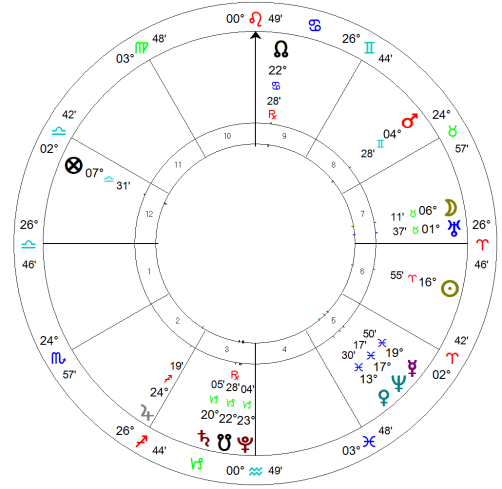
If you’re looking at your circular birth chart, you’ll see it divided into twelve pizza slices. Starting with the point on the circle furthest over the left-hand side (the nine o’clock position), you will then count forward counter-clockwise to number them off. See where the Ascendant degree is in that graphic? Everything in a counter-clockwise direction, to the next line or “cusp,” is the first house.

So, the first house in that chart is the pie piece that starts at 26 Libra 46 and goes to 24 Scorpio 57.

However! A tricky bit quickly arises: when using quadrant houses, if a planet is within 5 degrees of the next house cusp moving in a counter-clockwise direction, we read that planet as being in the next house. Looking at that same chart, we see that Jupiter is at 24 Sagittarius 19, but the 3rd house line falls at 26 Sagittarius 44. Since that Jupiter is within 5 degrees, we know that this Jupiter is a 3rd house Jupiter.

That five-degree “buffer” until the dividing line is what we call the “cusp” of a house, which doesn’t mean boundary; it means point or apex, like the points on your canine teeth: it’s why those teeth are called “cuspids.” It’s the seat of power related to that house, and planets on the cusp have a big impact in the affairs of that house.

For example, we might think of the second house in your birth chart as your stock room: it’s where all your inventory and resources are stored. A planet sitting right on the 2nd house cusp is in the middle of your stock room, doing whatever it is that planet does: if it’s Jupiter, he’s making money for you, but if it’s Mars, he’s probably spending money. “You gotta spend money to make money, honey,” he says.

But, he’s not in charge of the stockroom. He’s just right in the middle of it doing his Mars thing.

Who’s actually in charge of the 2nd house? Well, whose turf does that cusp fall in? To figure this out, we look at the sign wherein the cusp falls, and see what planet rules it.

So, if the 2nd cusp falls in the sign of Leo, the ruler of Leo is then in charge of the 2nd cusp. In this case, the Sun rules the 2nd cusp and will describe your relationship to money in some way.

How do I figure out how to divide the houses in my birth chart? I heard something about whole sign/Placidus/Koch/&c. houses… what’s all that about?

Technical Ramble Alert!

What you’re thinking about is the issue of house division, which has been a logistical problem within the astrological community for centuries and has engendered more than one loud argument in restaurants at conferences throughout the years.

Conceptually, houses are divisions of local space using astronomical considerations. There are… more than a handful of different criteria around which you could divide this space. You could use time to divide space. You could use… space to divide space (how’s your spherical trigonometry?) You could just use the Zodiac itself to divide space. It’s like cutting a pizza into 12 pieces. We generally want the result to have nice, even pieces.

But different astronomical criteria (yes, astronomical, meaning things that we are observing about the sky) determine how those pieces are divided. Broadly speaking, most systems of house division use either a reference to a point in the Zodiac, usually the ascendant, and then project houses from there on a sign-by-sign basis (whole sign houses and equal sign houses do this), while others, like Placidus, bring the degree of the midheaven into the equation, creating some complicated math.

My friend Ryhan Butler did a series of Twitter threads on the rationale for the way most of the popular house systems are divided, and if you want to do a deep dive, head over there!

BUT HOW DO I PICK ONE

Just pick one and stick with it long enough to learn how it functions and why it functions. In my practice, I waffle between whole sign houses and Placidus houses for natal astrology (although I gave up whole sign houses for Lent this year to build some consistency of interpretation…), but I use Placidus exclusively for horary.

The point, especially if you’re new to learning astrology, is not to win an argument; the point is to have results that help lead you to richer understanding of your own chart and the charts that come into your life. So!

How do I actually interpret the houses in my birth chart?

Let’s start off with the idea of angular triads. There are four angles in your birth chart. As each day goes by, if you’re looking south, the sky appears to rotate in a clockwise direction. We call this direction “primary motion.” Planets rise at the ascendant, culminate at the midheaven, set at the descendant, and come to their lowest point at the imum coeli, AKA the cusp of the 4th house.

Those four turning points are called “angles,” and initially were described with a word that also meant “tent pegs.” Those four points are the most significant points in your chart, and anything placed within those houses has more to say about your overall life and experiences. So start off by looking to see if you have any planets in the 1st, 10th, 7th, or 4th houses.

Planets in the houses that come before the angular houses in primary direction (remember, clockwise is primary) are called “succedent.” If we think of each of the big four angle house cusps as a throne, planets the succedent houses (2nd, 11th, 8th, and 5th) will, as the day goes on, succeed to those thrones. Conversely, planets in the houses that come after the angular houses in primary direction are called “cadent.” They were on the throne, but now they’ve lost their opportunity and have fallen out of power (which is what “cadent” means).

We can then divvy out the houses into three categories: succedent, angular, and cadent. Planets in angular houses have all the opportunity in the world to manifest what they promise; planets in cadent houses have lost that opportunity and are regrouping. Planets in succedent houses are movin’ on up but aren’t quite there.

Now, just because a planet is in an angular house doesn’t mean that it’s doing its job well, which is why understanding planetary condition is crucial—but that’s for another blog post!

Let’s get to the overall meaning of the houses, then. I won’t go into the rationale for why these meanings are what they are; that’s been treated at length by lots of fantastic astrologers. What I do want to point out is that there’s disagreement on the meanings of some of these, for sure.

Modern astrology understands the meanings of houses that Dane Rudhyar articulated in his lovely book “The Astrological Houses,” where each of the houses is viewed as a part of an unfolding life cycle. That’s not what I’m presenting here.

What I’m presenting here represents the consensus of the classical astrological tradition as found as common threads through the astrological texts of the middle ages, renaissance, and baroque era. Try these out, see if you like them, and if you get stuck on the meaning of a house or if it doesn’t land, let it marinate until it clicks. Many of these are drawn from the “joys” of the planets: if a planet delights to be in a house, it impacts the overall meaning of that house.

    • The first house is the joy of Mercury and it relates to you: your baseline personality, underlying motivations, style, appearance, and vitality.
    • The second house relates to money, especially your money, and resources that you have access to which enable you to support yourself.
    • The third house is the joy of the Moon and relates to communication in general, but more specifically to communication with people who are in your local space. There’s a “your zip code” element to the third; it represents your peers, siblings, neighbors, and really anywhere within commuting distance. It also relates to matters of the mind, gathering knowledge, primary education, news, rumors, and reports.
    • The fourth house relates to matters of ancestry, parents, family, and your sense of “home;” it also relates to matters of the land, and the legacies that you leave.
    • The fifth house is the joy of Venus and relates to matters of sensual pleasure, fun, recreation, procreation, and creativity. Sam Reynolds calls this the house of swagger; where you go to express yourself and put more of yourself in the world.
    • The sixth house is the joy of Mars and relates to matters of disease and illness. It also relates to drudgery, hard work, labors, servitude, and people who work for you. It also represents pets and small animals!
    • The seventh house relates to one-on-one interactions, most commonly marriage or romantic relationships, but it also has signification of anyone with whom we are engaged, such as the opposing party in a lawsuit, the business partner we would sign a contract with, or our enemies.
    • The eighth house is the house of unavoidables: death, debt, and taxes. Since it opposes the 2nd house, it has significations of other people’s money. It also represents inheritances you might receive from the dead, as well as your relationship with fear.
    • The ninth house is the joy of the Sun and relates to matters that enlighten and elevate our perspective: religion, philosophy, higher education, and travel to far-off lands. It’s everything that the 3rd house isn’t; if the 3rd is focused on here and now, the 9th is focused on everything else. Publishing and mass communication is part of the story here; 3rd is generating content, 9th is getting it out there.
    • The tenth house, called “Acts” in Greek, is what you’re known for, the way you appear within public perception, career, vocation, and accomplishments.
    • The eleventh house is the joy of Jupiter and relates to the people whose company you keep: friends, groups, affiliations, associations. It also describes the positive boons and opportunities which come your way and your aspirational longings.
    • The twelfth house is the joy of Saturn and relates to matters of sorrow, isolation, separation, and imprisonment. Kelly Surtees describes it as a “Pandora’s Box” of all the stuff that you’d rather forget about that can be brought to the surface by transit.

Now, the key to interpreting how houses function is to figure out which planet rules the house and to look at the condition and placement of that planet in your birth chart. We can use this extremely basic formula to get us rolling:

My [nth] house cusp falls in [sign]. [Sign] is ruled by [planet]. [Planet] is in [good/bad/eh] condition in [x] house. My relationship to [nth] house affairs manifests in a [planet] style using [matters of the house the sign ruler is placed in]. This leads to [positive/negative/mixed] outcomes relative to matters of the [nth] house.

Since I’m a Sagittarius midheaven, I’ll use my own chart as an example.

In my chart, the cusp of the 9th house falls in Scorpio. Scorpio is ruled by Mars. Mars is in overall good condition in my chart in the 2nd house. My relationship to 9th house affairs manifests in a Mars style using matters of the 2nd house. This leads to generally positive outcomes relative to matters of the 9th house.

I’m an impulse spender when something resonates with a goal or ideal that I have. In fact, I spend a lot of money, but I try to spend it in accordance with my ethics around money!

Let’s try another one!

Say you have the 7th house cusp in Libra with Venus in Capricorn in the 10th in a night chart, applying to the conjunction of Mars, with the Moon applying to trine Venus from Taurus. That’s a strong Venus, helped by Mars and supported by the Moon. So it would look like this:

In your chart, the cusp of the 7th house falls in Libra. Libra is ruled by Venus. Libra is in overall good condition in the 10th house. Your relationship to 7th house affairs (relationships) manifests in a Venus in Capricorn style (strong, determined, suffers no fools) within the realm of your 10th house. This leads to positive outcomes relative to matters of the 7th house; you might meet your partner in a work setting, or you and your partner might join together to found a company (since in this instance, Mars would be your ascendant ruler as the ASC would fall in Aries).

Remember what I said especially about planets in an angular house (both Mars and Venus are in an angular house, the 10th here): this part of your chart will have a lot to say about your overall life story! It’s turned up to 11, so to speak. This synergy between Mars and Venus in your chart makes your professional achievements a major factor in the stories people tell about you.

What if I have empty houses in my chart?

That’s not anything you need to worry about. I’ve heard of people told that they won’t have kids because their 5th house is empty… that’s bunk, sorry. Even if a house is empty, it still has a ruler, and that ruler is still placed somewhere and doing something. If your 2nd house is empty, you’re not going to be broke because of that; look to the ruler of your 2nd and see what’s happening with it! Use the formula, tell the story!

That said, understanding the condition of a planet is crucial to getting accurate interpretations for each placement. I’ve not yet written a lot on understanding planetary condition, but if you want to do a deep dive, Demetra George’s new book is the text you want to get to start getting the mechanics in your head (affiliate link ahoy!): get it here!

Meanwhile, over the next twelve weeks, I’m going to be offering one post for each of the houses going through its ruler being placed in any of the other houses! That’ll cover every possible combination.

In the meantime, if you really want to do a deep dive into understanding your house placements, there’s no better way to do that than by working one on one with me in an astrology consultation. Your chart will come alive in ways you didn’t expect just by getting another set of experienced eyes on it, and I absolutely can’t wait to work with you!

get your houses in order: book a session with me today!

Featured Image by Jakob Owens via Unsplash