The Heavens are Telling: Christianities & Astrologies

I.

Two weekends ago I spent six days in Chicago with 1,500 of my closest friends—the fellow weirdos who believe and act as though there is something to be said for the way the motion of the heavens around us actually does correspond in meaningful ways with what’s happening on our pale blue dot.

It was much akin to my first experience ever attending an LGBTQ Christian conference: people from all walks of life gathered around this One Significant Thing™ they have in common, and for a few fleeting days, were able to be fully who they are while finding themselves enriched by the nascent and long-standing relationships with others “like them” within what amounts to a community of faith.

Let me say this at the outset: those of you reading this who haven’t had an experience of a faith community (or perhaps for whom “faith community” is a triggering appellation) might not immediately intuit where I’m going with that turn of phrase to describe our shared experience at the United Astrology Conference but stay with me.

One of my cherished memories from the weekend was sitting next to Dayna Lynn Nuckols in Dr. Dorian Greenbaum’s talk on the daimon and writing notes back and forth as though we were kids scribbling on the bulletin in church to communicate just how excited we were to be there as we related the content of the talk to our own experiences of mainstream religiosity and practice. We were gone to church, wouldn’t you know it, and we sat in that meeting room about to shout and holler praise.

Faith communities emerge out of people gathered around ideas that matter to them. And indeed, what was the UAC experience but a wave of people gathering around an idea that matters to us? That shapes the way we live and move and work in the world? That gives us insight into ourselves and our neighbors and assists us in moving through the world as a healed and healing people, cracked open in compassion to one another?

My post-conference high was shattered when I received an email on Sunday morning from a family member articulating “disappointment,” concern for my “mortal soul,” and overall rehearsing the same kind of emotionally abusive rhetoric that emerges out of fear of the unknown in a bid to shame me into dumping astrology. The curious thing is that the content of that email was almost word-for-word the same kind of acerbic critique I expected and, in some part, received when I came out as a gay man in 2012. It was the same kind of rhetoric which I still have to deal with from time to time coming from people who don’t see how “gay” and “Christian” can coexist within the same person. I’m fortunate in that I’ve got a tough enough skin to be able to handle it at this point in my life, but such was not always the case.

Indeed, for a split second I considered taking down my website and social media account and dismissing all my clients in order to appease this family member whose opinions, concerns, and expectations I’ve desperately tried to meet my entire life. I just want to make them happy and proud of me at the end of the day (after all, I have their corresponding house ruler conjunct the IC and in detriment natally). But I held back, relying on the steel in my spine that this person’s loving presence and influence in my life had put there. As my blood pressure dropped and I began to see straight again, as the pounding in my chest abated, I drafted the best response I could and sent it in order to set a boundary.

II.

As I chatted with astrologer upon astrologer in Chicago about my life and work, I found it endlessly fascinating that my vocational identity, specialized training, and professional life proved not to be a turn-off or a barrier to having conversations, but rather served as a point of entry for deep and soul-expanding exchanges of spirit, intention, and joy. What I have not made public on this site is that I am a pastor in a mainline Christian denomination and am actively serving a church, doing theological work, and directing my energies and my efforts in a bid to make the world a better place from the narrative framework of my faith tradition. My divinity school training and study of classics has made stepping into the Hellenistic worldview in order to interact with and contextualize it in astrological practice as easy as changing lanes on a country highway.

So as these conversations emerged and progressed over the course of the weekend, what came to the fore was an emergent desire (or so I perceived) from astrologers to see how mainstream religiosity might, in fact, have room for astrology therein despite the supposed prohibitions against divinatory practice within the Tanakh and the New Testament. I mention those specifically because they have arguably been, along with the Koran, the most influential sacred texts in the West. And Lord knows, those same texts have been levied as bludgeons against people with “outside the lines” spiritualities and religiosities, like me, to the same extent that they have been weaponized against people—also like me—who have “outside the lines” sexual identities, politics, or anything that does not serve the express purposes of the party in power (viz. cishet Caucasian men).

Being explicitly for or against any one practice, activity, posture, position, or what have you “because the Bible says so” is the least helpful of any argument precisely because it fails to take into account the socio-political context of the people who generated the sacred text, and likewise it depends on several hermeneutical and philosophical assumptions that the person who receives such an argument does not necessarily share. Such Biblicism assumes that the world is indeed stacked towards the people in power, and belief in a rarefied and systematic collection of truth claims adapted from scripture becomes the means by which people in power gatekeep who is in and who is out (when, interestingly enough, the narrative arc of scripture suggests that God is roundly on the side of the powerless).

It is ever tempting simply to jettison the text and its attendant traditions of faith as a relic of a bygone era and to set out on uncharted territory. The desire to say “byeeeee” to the Church wholesale is an attractive one—I know this as well as anyone, having spent the better part of the last six years fighting for my rightful place at the table as a homosexical. I have a suspicion that this is the path that many astrologers took: they saw the way that the Christian story had been made into a prod for separating the sheep from the goats, so to speak, and I suppose many would rather the Bible, its story, and its interested parties simply disappear into the ether.

Yet that cannot simply be, in my estimation; the presence of the sacred text in history and people’s actions in response thereto is something that all people need to recognize whether they claim a faith tradition or not simply because of the extent to which a Constantinian Christianity shaped the unfolding history of the west for the past, oh, 1650 years (give or take). And, just as a “faith community” of sorts has emerged around astrology, so have faith communities emerged around the shared idea of the meaning and power behind this mythic narrative and our fractalized interpretations and manifestations of the same.

III.

From everything I can tell, people want to know how Christianity and astrology might coexist and, perhaps, even improve one another. I hope to do this work, but to be frank, there is too much to be said. The issue is that there are more than one astrology, and there are more than one Christianity, both of which are reminiscent and influenced by the value memes operant in society at any given time. As I continue this conversation, the terminology of Spiral Dynamics is going to factor in prominently, so I would recommend listening to this episode of the Liturgists podcast as an accessible introduction, or this article from Spiral Dynamics Integral as a starting place.

Leaving aside the question of astrologies for the moment, let’s consider the fact that there are more than one way to skin a Christian. These different stripes of the Christian movement are, as I said, largely determined by socio-political factors and the dominant value memes out of which particular communities arise throughout history.

By far the loudest and most vocal component of Christianity in the West is the evangelical stripe who has created an entire metanarrative of themselves contra mundum and whose entire understanding of their faith story is that the world is going to hell and needs to be saved as swiftly and decisively as possible. One receives salvation, of course, putatively by “making a decision for Christ” and saying a particular prayer (which is magical thinking if I’ve ever seen it), and such decisions are arrived at by any collection of tactics, to include emotional coercion and clever leveraging of societal benefit.

The tragedy here is that most evangelicals don’t realize they’re engaging in this sort of manipulative behavior, and what’s more, evangelicalism as a whole has been coopted by those who would manipulate them with promises of societal position in order to garner political support for agendas that stand in stark contrast to the anti-imperial ethos of the man from Nazareth.

These are arguably the Christians with the most airtime and presence in media, which is a damn shame, because of the PR problem such religiosity has created for the Christianities whose theory and praxis are rooted in the non-violent and contemplative ministry of Jesus among the marginalized. Conservatism isn’t a good look for the Jesus movement, because the whole thing was about coloring outside the lines of society and finding people whom society had said “you’re worthless” and telling them, “no, in fact, you’re worth more than you can imagine and you have a part in healing this world, too.”

That said, there is a tension between the value memes that generated Constantinian Christianity (viz., Christianity as a political power) and the value memes that generated the original community of all the wrong people that gathered around Jesus of Nazareth and his closest friends. Consider the emergence too of monastic communities and off-the-wall renewal movements throughout the history of the faith tradition too: with their hearts set afire by a mystical experience of union with the divine, folks attempt to bring that to the greater mainstream church, and voilà, in attempting to nail down something that is ultimately impossible to encapsulate in words they have created a new denomination or sect. Such was the case with the church of my upbringing, the Methodist tradition, and such has been the case with any number of communities, sects, denominations, or branches of the Jesus movement. I daresay the very same mechanic is responsible for Paul of Tarsus penning the bulk of the New Testament.

My point is that Christianity can never be understood monolithically but is best understood as a collection of Christianities that have emerged as different communities with different priorities rooted in their particular value memes, priorities, and ways of talking about the thing we call “God.”

All that to say, my Christianity and the Christianity of the person who sent me that email are not the same. My Christianity and the Christianity of the better part of my congregation are not the same. My theological methodology is not one that jives with American Evangelicalism, such to the point that there’s not enough common ground between us even to facilitate a conversation. Moreover, the way I approach astrology as a component of my Christianity will not work for everyone either.

“How then shall we live?”

IV.

For now, I want to begin this whole foray into the question of astrologies and Christianities with this: I came to astrology in earnest not because my mom forbad me from reading the newspaper horoscopes as a kid (thereby ensuring that I would do everything in my power to read them), but because the Christianity I had been handed from my upbringing and my divinity training wasn’t leading me into the contemplative experience of God that I needed. It wasn’t dealing with the questions I was facing. “Believe, behave, belong” did jack shit to account for the active suffering of the world and the suffering I had personally undergone in my life. Yet the mythos of the Christian story was so integrated into my bones that I couldn’t simply excise it wholesale.

I know from my own personal experience that the practice of my astrology has, for lack of a more elegant way to say it, made me a “better Christian.” By that I mean that astrology in general, and horary in particular as I’ve received it from the Lilly tradition, has become a means of seeing beyond the myths that our egos, complexes, and presuppositions about The Way It’s Supposed to Be™ would readily present to us as fact.

Astrology has given me not only a way to sit with these questions, but it has also assisted me in listening to the “sound of silence,” to borrow a phrase from Elijah’s conversation with God on Horeb, to know deeply that my actions are emerging from a place that is in harmony with the will of the One who holds the universe together in an all-loving embrace and powers the whole thing with an engine of illimitable joy. To borrow a line from Paul of Tarsus, who in turn borrowed it from the pagan writer Aratus of Cilicia, “in him we live and move and have our being” (cf. Acts 17).

It has helped me to understand, in some mystical way that quite defies words, that I have a place in the Universe that is intended and purposeful as much as any of the planets or stars or plants or insects or plankton or fellow human beings have, and such place is a place of love and of grace and of the voice of a divinity that calls us each into being by name and calls us “very good” on the first page of the story, a divinity of whose weight “the heavens are telling,” and whose handiwork “the firmament proclaims” (cf. Psalm 19).

And because of all of that, I can see, ever more, the image of the one whose love binds the universe together emerging in my neighbor—their Jupiter, their Saturn, their nodal placement, their ascendant, whatever, all bearing witness to the unyielding diversity of the One in whose image they were made. Seeing the image of the Cosmic Christ in people you’d prefer simply to relegate to your own concept of hell and be done with it will mess you up.

V.

There’s a tremendous amount to be written on this. Truthfully, I have no desire to create a “here’s how astrology systematically interfaces with Christianity” manifesto and promulgate it as the only option for engaging in this conversation—that would defeat my purposes entirely! That said, here’s what I’m going to attempt to do in this process of unpacking Christianities and astrologies:

  • I intend to articulate my own theological and hermeneutic methodologies in a way that is as accessible as possible. My astrology is a component of my theology so I have to go in that direction first. Suffice to say, as a postmodern theologian I am in good company.
  • I’ll do this by looking at individual concepts on which my astrology leans from a narrative framework, for example, the trinity, the Cosmic Christ, the incarnation, and the resurrection. In this, I am solidly a panentheist (which, bafflingly, is the historic understanding of the nature of God among the mothers and fathers of the desert).
  • At the same time, I’m going to attempt to offer historical-critical insight into some of the “clobber passages” against divination with an eye towards the socio-political realities of the people who generated the text. The short version is this: if a people group is in slavery in Egypt and exile in Babylon, they are going to take issue with the practices that support those regimes, viz. astrology, and their mythos is going to be stacked against the powers of those entities.
  • I am going to interact with the text’s treatment of the concept of divination in general and astrology in particular. I know full well I will never win over any fundamentalist by making appeals solely to textual evidence. I’m not going to try. But, I will attempt to highlight some of the ways that the Tanakh and New Testament speak to the revelatory importance both of the heavens and of divinatory practice in general.

I don’t have an agenda in any of this other than to articulate and demonstrate how various Christianities and astrologies may coexist and cooperate, while offering some encouragement to those who perhaps have some tension or cognitive dissonance about the two coexisting within themselves. I desperately believe that the union of the two can enrich one another and assist people in their respective journeys to integration, wholeness, and union with the “LOVE which moves the Sun and the other stars” (Dante, Paradiso, Canto XXXIII). Astrologers are my people, and weird-ass Christians are my people too—as is anyone who has been told that they don’t belong. I don’t belong either. I love you all.

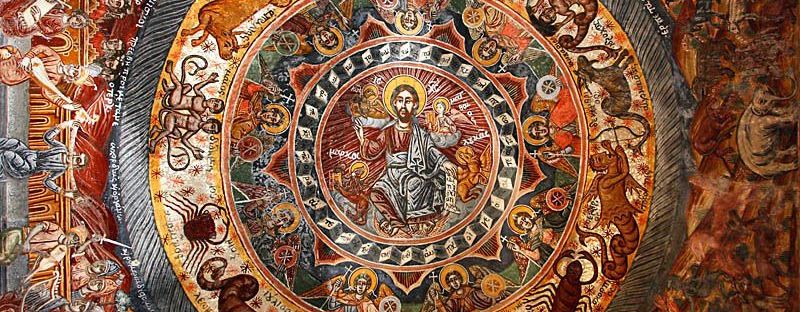
The featured image is a fresco from the Dekoulou Monastery in Greece, a community of the Greek Orthodox Church.


When the stars give you spoilers: why I love horary astrology

I’m often asked by folks—my ever-patient husband among them—why I favor horary astrology over the practice of something more well-known like natal astrology. My reasons aren’t overly complicated, but to get there I’d like to mention the difference between modalities of astrology.

Think about intelligence for a minute. The psychologist Howard Gardner delineated a theory of multiple intelligences in his 1983 book, Frames of Mind: The Theory of Multiple Intelligences. In short, Gardner proposed that the bigger concept of intelligence was better conceived of as subsisting in eight specific modalities, to include such things as verbal-linguistic intelligence (what you use when speaking or writing), logical-mathematical intelligence (what you use when solving logical or arithmetical problems), or intrapersonal intelligence (what you access when you are reflecting on your own interior emotional and cognitive life).

Gardner’s theory supposes that there’s not one overarching construction of intelligence, but rather, different people have different strengths and weaknesses in terms of the facility they have with each of these modalities.

So, by way of parallel, we can talk about astrology is an alternative means of knowing that has different modalities. If astrology is an intelligence, a language of symbolically meaningful correlations that we can utilize to tell stories about the way our lives shake out, then I would suggest that we can look at horary and natal astrology as being two different “modalities” of astrology that have a lot of overlap but necessarily deal with different things. The same set of rules that governs natal astrology also governs horary, more or less (especially if you’re a traditional astrologer), but they have wildly different applications.

So why do I prefer this particular modality of astrology to natal—especially since I also practice natal astrology?

One: horary astrology is results-driven. Either the horary astrologer gets the judgment right, or they don’t. At the end of the day, what drives a person to seek out the assistance of an astrologer is a specific precipitating event that has driven them to a crisis. And I think “crisis” is the right word here, because the Greek word from which we get our word “crisis” means “judgment,” which is what a horary consultation endeavors to do. We get the chart of the crisis (in the form of a question) and judge what will become of it.

Two: horary astrology is a powerful intervention tool. Because of the nature of some of the questions that horary astrologers encounter in their practice, it is often bringing us face to face with the challenging realities of people’s individual emotional, relational, vocational, and financial crises (or otherwise). The astrologer, then, has the sacred responsibility to treat the client’s question or concern with the patience and unconditional positive regard such a situation may demand. The astrologer then has the opportunity to speak directly into the client’s crisis, using the wisdom of the chart.

In my practice I’ve found that the very process of working with a client to massage a question into something that is clear and answerable with a horary consultation is illuminating both for the astrologer and for the client, who may have some unspoken challenges or matters which they are not addressing in the question but are critical for understanding how to move forward from the consultation space; these matters make themselves readily apparent in the chart of the question.

Three: horary astrology is concise and accessible.Dr. Lee Lehman, one of the biggest names in the traditional astrology world and one of my mentors by way of the STA, said something in an interview with Chris Brennan on the Astrology Podcast that has stayed with me for quite some time: “We have our entire lives to work out our natal charts.” Natal consultations are hard because we really are speaking about an entire lifetime of subjective and objective experiences and trying to make sense of the story that is underpinning all of them, which, if we’re not focused in how we’re approaching the natal chart, can cause us to become lost in a forest of subplots and details that don’t further the client’s understanding of their life station.

Meanwhile, a horary judgment is zeroed in on one specific issue or concern, and it’s not something that we need to spend the rest of our lives puzzling about it. As well, despite the complex nature of the rules that govern the practice of horary astrology, a story can be told clearly and concisely to the point that the practitioner need not make recourse to any astrological terminology.

A joiner to this: the best horary charts have strong connections to the querent’s natal chart for sure, and I have seen this come to bear in my own life even as recently as this week.

Four: horary astrology is rules-driven and rooted in tradition. The whole practice of horary astrology works because of the tight rules that govern the interpretation of horary charts which have been handed down from the ancient near east through medieval Europe and ultimately, through the rediscovery of William Lilly by Olivia Barclay and her successors in the traditional astrological revival of the late 1980s and following.

The rules of horary follow a clear, logical order, and because of that, they are straightforward to learn and use systematically to all manner of charts. There are a lot of rules, though, so there’s a little bit of a barrier to entry for folks who haven’t exercised their memorization chops in a while, but all the same, this art can be learned and taught effectively precisely because of the clarity of the rules.

I especially love it because all of the symbolism in the chart comes out of following these rules; for example, Mars and Venus coming to a conjunction in Scorpio is going to tell a vastly different story than Mars and Venus coming to a conjunction in Libra. The best practitioners are those whose attention to the rules are joined to intuition in a way that supports the clear and precise interpretation of the chart.

Five: my personal experience has validated the power of horary. I put this one towards the bottom of the list because I was already deeply attracted to and invested in my study of horary by the time I had any remarkable experience of it in my own life. It wasn’t until I was wrapping up my studies in the practitioner’s level course at the STA that I asked and judged a question for myself, a career matter that is still playing out in ways that are, frankly, uncanny (which I won’t get into here). The chart spoke concisely and directly to a decision I was making and, two months ahead of time, predicted a new and important collaborative partnership that would emerge in my day job that necessitated me remaining deeply rooted therein.

So, yeah, it works.

In sum, I love this art simply because when questions are asked with sincerity and openness to whatever it is the Divine has to say about the matter, it works, and it gives the kind of clear, direct, and constructive feedback to which modern life has grown accustomed. And, honestly, I think it’s for everyone; yes, the rules are arcane and require lengthy investment of time and energy to learn and deploy well, but the number of astrologers who have the knack for this is growing and the art is becoming more available to people who otherwise wouldn’t know that they have recourse to the heavens.

Do you have a pressing, personal question that you would like to address with horary astrology? Send me an email today!

Cover photo by Steven Hille

On Uranus in Taurus

A lot of folks seem to be worrying the Uranus Taurus ingress to death. With these outer planet transits and ingresses, we expect big things to occur on the world stage. Uranus’ trips through Taurus have a way of coinciding with major shake-ups to the foundations of society; his last transit of Taurus lined up with that weird and worrisome period between the Great Depression and the outbreak of World War II. But bear in mind that Uranus in Taurus was not the only thing happening at that time.

What I want to make clear here is that Uranus’ property is not to create geopolitical crises. His property is to disrupt such that it forces adaptation. Uranus qua Uranus is the crisis waiting to happen, the precipitating factor, the change agent.

There’s a reason that a number of astrologers are starting to refer to this planet as Prometheus. In his myth, Prometheus steals fire from the gods as a boon for humanity, but then humanity still has to adjust to the new reality that having access to fire engenders for everyone. All Prometheus did was say, “here you go, now deal with it.”

Uranus queers–that is, Uranus makes things weird. Honestly, I need more astrologers to be talking about Uranus power to queer. Whichever house cusp Taurus lies on in your chart will be queered with this ingress.

Consider what it is that the Fab Five do on any episode of Queer Eye: they come in unexpectedly, rumble around a man’s entire wardrobe, living space, grooming, pantry, and confidence, leaving no matter untouched. And the men whose lives they impact, though they are completely unsettled and jostled around by this process, come out on the other side for the better.

Uranus will draw the elements and qualities of all that which is on the outside, the margins, the unexpected—”All things counter, original, spare, strange; / Whatever is fickle, freckled (who knows how?) / With swift, slow; sweet, sour; adazzle, dim;” to quote Hopkins—right to the center, where it will demand adaptation. The power of the Fab Five is not that they come in and teach a man how to wear pants that fit; they teach a man how to make manifest his divine dignity by uprooting his comfort, his ugly-ass dad sneakers, and addressing the emotional baggage that caused that man to become stuck and fixed in the first place. In other words, Uranus will be the sand in the particular oyster that Taurus represents in your chart, as he always is and always does. She ain’t give a damn, hennie.

That’s the gift of queerness. We exist on the margins and when we draw the margins to the center through our presence, we create an adaptive crisis for the status quo. For me, Uranus was transiting my third whole sign house (second Placidus) and so much of the last seven years was about queering my relationship with traditional religion, which is now my day job—as well as learning how to talk about my own queerness and communicate it. There were any number of crisis points on the way that played into the whole theme (which I won’t list here), but looking back, I have a clear view of what it was that Uranus was doing in my life over the last seven years.

This goes to show that even though the precipitating crises Uranus instigates might be tied to specific events, those are amplified points of the overall theme of the transit. Is Uranus hitting favorable aspects to planets in your chart? Be ready for boons you aren’t expecting that still require you to adjust. Squares or oppositions? The same, but those will be tougher.

Regardless of the quality of the transits themselves, whether we experience them as positive of negative, we still have to be flexible, and each of the specific contacts between Uranus and other planets play into the overall story of this transit.

And we can sit around and speculate, but all the while, Uranus transits are by their very nature unpredictable. We can refine the possible manifestations of a Uranus transit by looking at our charts, but ultimately, the odds are that we won’t be able to nail down exactly what it’ll be until after the fact.

Worrying possible transits to death will make you rigid, and rigid can’t deal with Uranus. Better to bend than to break. So, friends, meet Uranus’ transits to your Taurus-placed house with Taurus’ cool head and patience. Think more Ferdinand under his cork tree, less rage-blinded animal charging at a toreador.

So I ask: what are the things that hold you to the ground? What is it that gives you a sense of stability and fixity? What are the material things with which you surround yourself in order to feel a sense of pleasure and peace? Uranus’ transit through Taurus is going to ask you to reevaluate anything that you would root yourself in, and that question is not going to come in the form of a gentle “have you considered this,” but rather, “oh by the way, your house is on fire and your investments are all over the place and your paycheck is screaming and your food is killing you and eat a vegetable and prom’s tomorrow!!”

So, as always, be prepared.

If you’re ready for a given area to be jostled in your life, if you can roll with the punches, if you can abide—and participate in—Uranus messing with all of your stuff, you’ll come out on the other side a reformed person. For our society, so rooted as it is in our relationship with money, this might necessarily mean some unprecedented shifts. And for each of us on our own, Uranus will come wheeling into whichever house Taurus is on and—as Prometheus did in the myths of ages past—hand us something fiery like “universal healthcare” or “cryptocurrency” or “food justice” and say, “well, here you go. Let’s zhuzh it a little.”

On Taurus

The Sun is now well into Taurus! So put on your sweatpants, grab a pint and a pizza, and settle in as we explore the meaning behind one of everyone’s favorite signs.

The three keys to understanding any sign are its element, its modality, and the planets that have dignity or debility there. Taurus is an earth sign, a fixed sign, and is the domicile of Venus, the exalted seat of the Moon, and the detriment of Mars. The fertile environment of Taurus is made so by its fixity and earthiness, as well as by the planets that have the most dignity here: Venus and the Moon. Venus rules Taurus; it is her nocturnal house, where she retires to re-energize for her work.

Comfort, luxury, pleasure, indulgence are the name of the game for planets expressing their energies through Taurus; their agenda is set by Venus and all of her natural rulerships. If a planet is able to go along with LUSH writ large, they do better here.

People born with their Sun in Taurus are people who understand their purpose in life to be associated with Venus’ pursuits: peace, beauty, luxury, harmony, enjoyment, and pleasure. The same is true of people with their Sun in Libra; however, since Taurus is an earth sign and a fixed sign, the Solar purpose expressed through Taurus can be described as maintaining the status quo in terms of relating to the material world. Because of that, and due to Venus’ rulership, who naturally rules material wealth, Taurus has close associations with finance and the material “stuff” of our life, to include commodities.

NB: Don’t confuse Taurus and the second house (which also deals with resources, money, and material things)! They are similar, but not ultimately related.

The stereotype of people with Taurus suns as “lazy” is somewhat rooted in reality, given Taurus’ affinity for relaxation and enjoyment, as well as its fixity and stubbornness. Yet Taurus suns can be incredibly hard workers—fixity and stubbornness, after all. But Taurus’ ability to work hard is best applied to Venerian and Lunar endeavors. The cultivation of peace, beauty, and emotional intimacy is something that Taurus suns find as part of their understanding of their purpose in the world.

That “peace” is not the same kind of empathic peace that Libra strives for (Venus’ diurnal sign); peace in Libra is about unity of minds, a morally and ethically just peace (Saturn’s exaltation). The peace for which Venus strives in Taurus is, instead, the idea of “shalom,” the idea of material wholeness: “Everyone under their own olive tree.” No one lacks for anything material. (Remember this when Uranus enters Taurus this year.) Likewise, the Moon is exalted in Taurus and so the peace for which well-adjusted Taurus suns strive finds its strength in emotional intimacy and connection. The Moon here leans on Venus’ power to unite.

Remember too that lunar placements indicate the direction we go when we encounter stress, as well as the way forward in responding to stress in a healthy way. Taurus Moons will attempt to numb themselves with too much pleasure when they are stressed; that is, the Moon will take too much out of Venus’ refrigerator when she encounters stress in Taurus and drink herself into a luxurious, lazy stupor instead of doing the hard Mars work of confronting stress.

Meanwhile, Taurus’ lushness demands fixity and stability because Mars is in detriment here. It demands slowness, and if a planet cannot relate with slowness or with luxury, it will not do as well here (cf. Mars).

Fleet-footed Mercury is peregrine for the second half of the sign; he has a little bit of dignity by either term or face for the first half of the sign, but Taurus’ fixity is not something that comports with Mercury’s shifting nature.

So what about a Mars in Taurus placement? Mars in Taurus is an anger that falls asleep to itself, that does not find expression until something triggers it and it explodes in bullish force, leveling everything in its path and shocking everyone who witnesses it. “How could someone so easygoing have such a bad temper out of nowhere?” Taurus Mars stuns everyone when he awakes; he must have an outlet. Taurus’ physicality gives a ready way forward—anything that routes energy and emotion through the body in a controlled and appropriate expression is a great way for Taurus Mars individuals to work off their anger.

Interestingly, Jupiter has dignity only by term for a small portion of Taurus and otherwise has no dignity throughout the sign, despite Jupiter’s friendliness toward Venus. While Jupiter enjoys pleasure and luxury too, Jupiter’s restless search for truth and expansion of its boundaries does not necessarily comport with Taurus’ comfort with the status quo. Folks with Jupiter in Taurus placements likely have a propensity to overindulge in Taurean pursuits and often attach spiritual or philosophical principles to material possessions. “The love of money is the root of all kinds of evil.” Defining one’s spiritual worth based on their material possessions is a risk for any Jupiter in an earth sign placement, Taurus included. “One cannot serve both God and Mammon.”

Of the earth signs, however, Taurus is the best place for Jupiter to be, as he is in his detriment in Virgo and his fall in Capricorn. This is because Jupiter, at the very least, can connect with Venus’ idea of “shalom” and turn that into an ethical principle for living. Interestingly too, Saturn has a similar “cordial acquaintance” with Taurus as well, being peregrine for two thirds of the sign. The collection of people born with Taurus in Saturn will find themselves encountering limits and obstacles as they relate with the matters that Venus rules from here: money, economic power, resources, commodities. Saturn always demands rightness of relationship and that we carry only that which is ours to carry—finance inclusive.

Cover photo by Nicolai Durbaum

Spring Cleaning: the Virgo Lunation

Today on the Twitter™ a friend posted the following:

The Virgo moon asked me to discern. Asked me to purge. Asked me to focus. In a way, this is what i imagine Lent feels like…♍🌛🌕🌜

To which I said, immediately, “hey, yeah, that’s exactly what Lent is about.”

In my faith tradition there is a season that precedes the holiest days of the year, viz. Holy Week, which culminates with Easter. We call this season “Lent,” or in Latin, Quadragesima. The word “lent” is related to the French word lent, meaning “slow,” which is evocative of the journey our tradition takes us on: we spend the forty days (quadragesima) preceding Holy Week slowing down, “discerning,” “purging,” “focusing,” to use the words my friend used, so that we can better appreciate the promises, the gifts, and the joy that the Easter season brings.

In a felicitous calendrical accident, we have a Virgo full moon marking the midpoint of the season. It so happens that, because of the way the calendar works and because of the calculation of the dates for both the Jewish festival of Pesach and the Christian celebration of Pascha, we always have this Virgo full moon occurring every year during this season—and it is exactly the symbolism of this particular full moon that so richly captures the process of Lent and similar processes in other religious traditions that seem to happen this time of year (to say nothing of general “spring cleaning” as the Sun makes his transit through double-bodied Pisces as winter dissipates and we shake out the dust of our hibernation).

The symbolism of double-bodied, or mutable, signs is rooted in the change of seasons as one season falls away and yields to the next. Each of these signs (Pisces, Gemini, Virgo, and Sagittarius) has an obvious “double bodied” icon: the two fish, the twins Castor & Pollux, the virgin Astraea and her eagle (or the Virgin Mary with the Dove, pick your legend), and the two-bodied centaur Chiron, the tutor of Achilles. Each of these signs marks the time of the year where the story of the year bridges two seasons, and each calls for adaptation, adjustment, and yielding to change.

Virgo is the double-bodied sign of the earthy triplicity: indeed, a full moon lunation in this portion of the sky speaks to the need to re-order and re-structure our very surroundings. This manifests, as I said, as spring cleaning for most of us in the northern hemisphere: many of us will spend time over the next weeks purging and getting rid of stuff that’s been hanging around, changing our sheets (change them more than once every three months, please), selling old stuff on eBay, vacuuming out our cars and washing the crust of brine off of them, changing the filters in our HVAC system, doing our taxes, and so forth. Some of us will also spend time out-of-doors, tilling the ground, fertilizing, mulching, and making our gardens and flower beds ready for another season.

But the energy of this particular lunation also manifests as a call to engage with the process of spiritual “spring cleaning” as well. What is it that demands our energy? What takes up room in our soul? What do we need to let go of? How do we re-order, in Virgo fashion, our material and spiritual existence in order to make ready for the next cycle of life? Those are questions that I can’t answer for you, but the placements in your chart may give you some guidance. For instance, this lunation occurred in my natal 7th house, at the trine of my Part of Fortune, and I’m finding that I’ve spent quite a bit of time and energy in the last day or so attending to money management and my spiritual relationship with my “fortunes,” so to speak.

Moreover, the Virgo lunation serves as a counterpoint to the Pisces sun, which signifies deconstruction: we can’t remain in a state of deconstruction forever and expect to continue to thrive, so the contrapuntal play of the Virgo moon reminds us to adapt to what we have learned through the process of the deconstruction that is a function of growth as humans.

Indeed, this lunation can be read as the cosmos bidding us to make ready for the great greening and renewal of the entire planet which occurs as the Sun ingresses into Aries each year. It is a call for us to breathe along with the breath of the planet, which the stories of our faith traditions bear out in festivals around this time of year: Pascha/Easter for those of us who are Christians, Pesach for our Jewish friends, Ostara for others, and on and on. So many of us, especially those of us who are making preparations for our respective holy days, will experience the energy following this lunation as “tidying up” energy that, when employed skillfully, can enable us to Marie Kondo our physical environments as well as our spiritual environments in order to reorder and restructure for the best growth possible.

So I give you this prayer or affirmation to hold in mind as you work with this energy over the next two weeks: “may I reorder and make room in my life and my heart so that I may feast on the joy of the Earth’s restoration.”