My Favorite Psychopomp: Virgo, Mercury, and the BVM

I’m undergoing something of a spiritual key change.

I’m playing variations on the same material I always have, but as my understanding has deepened and broadened (and as Jupiter has been transiting my 9th house in Scorpio), I find that these days I’m playing this material at a new pitch level that’s requiring any number of adjustments to compensate for the untold variety of different harmonics and intonations that my life’s song is generating at this new pitch. In fact, it’s almost as though there needs to be a pause for re-instrumentation, because some instruments can’t play in A major as easily as they can play in B-flat major, if you’ll allow my overblowing of the metaphor.

The Blessed Virgin has a hold on the scruff of my neck that doesn’t seem to let up, regardless of how my spiritual schemata continue to shift and grow and change under Jupiter’s enervating influence. She’s been in my corner for quite a while, as far as I can tell. Which is why this particular Virgo season has me thinking more deeply about the connection between the sign of the Virgin and the person of the Virgin, both as an archetypical reality and as a means of interpreting things going on in Mercury’s nocturnal home.

The association between Virgo and the BVM is a facile one, and I’m well aware that there are any number of myths undergirding both the sign and the constellation of the same name—most notably Astraea and her Eagle—but, for me, the connection to the BVM mythos is doubly strong because of my particular religio-cultural context. I’m also a Virgo Sun, so, I have lived the bulk of my life growing into an understanding that a fundamental ego purpose of my existence is to adapt and to perfect within the material realm.

While listening to commentary on Virgo placements during an episode of my friend Melanie’s podcast, I suddenly found myself thinking once again about this connection between Virgo and the BVM not because of any sacred baggage we might attach to “virginity” but rather because of the idea of “adapting to material learning” that Demetra George uses as a byword for Mercury’s purposes in Virgo.

Virgo is, when you’ve gotten down to the heart of its significations, primarily about making things real. This is why Jupiter struggles so hard here, and most Virgo Jupiters I know skew towards a particular kind of over-examined rigidity whether in faith or in skepticism. Mercury, however, rejoices to make things real, taking ethereal concepts like words and meaning and value and transmuting them into material things that we can pick up and share and carry around with us and distribute and hoard—things like money, or books, or words, or even ideas themselves. Mercury transforms the extraordinary things of our hopes and dreams and wildest imaginations into the ordinary stuff of everyday life, but in the most extraordinary of ways.

With this movement towards reality in mind, I want to look again at what I consider one of the peak moments of the story of Mary in the New Testament, namely, her song of exultation after having shared with her relative Elizabeth what has happened to her, viz., being told by the angel Gabriel that she is to give birth to a messiah:

My soul doth magnify the Lord,
And my spirit hath rejoiced in God my Saviour.
For he hath regarded the low estate of his handmaiden: for, behold, from henceforth all generations shall call me blessed.
For he that is mighty hath done to me great things; and holy is his name.
And his mercy is on them that fear him from generation to generation.
He hath shewed strength with his arm; he hath scattered the proud in the imagination of their hearts.
He hath put down the mighty from their seats, and exalted them of low degree.
He hath filled the hungry with good things; and the rich he hath sent empty away.
He hath helped his servant Israel, in remembrance of his mercy;
As he spake to our fathers, to Abraham, and to his seed for ever.
(Luke 1.46-55, KJV)

There is a lot that could be said here, but I want us to think about this: the story of Mary, a peasant girl from a nowhere town with no social prospects, who has become pregnant out of wedlock and has an unbelievable story about precisely how that happened, who is part of a people group who live under the thumb of oppression, has every reason to expect that her wildest dreams will never come to fruition and to linger in Piscean/Jovian dissolution. To wit, she is easily the first candidate for someone we would imagine would have no recourse in this world but to escape into flights of fancy.

But if we notice how the writer of Luke’s gospel has recorded Mary’s words, we notice one thing: nothing is in the subjunctive. All of her declarations are in the perfect tense; they have been accomplished, and there’s nothing left to wait for or to let remain the purview of dreams. Notice too that Mary’s Mercurial song of transmutation and magnification takes an easy potshot at everything Jupiterian or Piscean: “[God] hath scattered the proud in the imagination of their hearts.” After all, magnification is the very process by which the small becomes visible.

Mercury has transmuted what we would expect to be Piscean idealism and dissolution into the here and now, and not just the spiritual here and now, but the real socio-political right here, right now—what Mary sings of is not “salvation” as in being removed to some far away place, but rather the kind of salvation that manifests in corrupt governments being overthrown and the last and the least being given, at last, justice and equity in their plight. Adaptation to material knowledge, indeed.

Virgo scatters imaginations and flights of fancy to magnify the utterly real day-to-day stuff; Mary’s song draws the reader’s attention to that which is most on the minds of this oppressed and colonized people group and states, in no uncertain terms, that what was once the exclusive purview of dreams and prophecies has become as matter of fact as the sky’s being blue. That seems to be what it is that Virgo does, and likewise what the BVM does with all of us who have a connection with her ancient and archetypical image: she magnifies and realizes, leaving us unable to let that which is most important to us remain the exclusive purview of some far-off hope.

I’d also add briefly that Mary serves an important role as psychopomp and intercessor between humanity and the divine. Considering the overlapping function of Mercury within Greco-Roman mythology, this is not something to overlook. I surmise that this is one of the reasons that the BVM-as-Virgo archetypical notion serves to reinforce the idea of the priorities of Virgo being servile and helpful. If Mercury in Gemini is a fleet-footed go-between, Mercury in Virgo is much more strongly connected to the idea of advocacy and assistance—an “in” with the divine, so to speak, which is precisely the BVM’s function in non-Protestant religiosity.

Perhaps this is another one of the reasons that I have such a devotion to her. Because I was socialized believing that God is fundamentally “male” (even though that’s not a defensible position theologically) and, after all, I’m afraid to talk to men. But I can talk to Mary any time with the ease and facility of talking to an old friend’s mom at the dinner table. This ease and facility is another one of Virgo’s key significations, for Mercury here can adapt immediately to any incoming information or material and get it precisely to where it needs to go in order to be most effective, just as Mary and other such psychopomp figures can route incoming souls, prayers, magics, etc. to precisely where they will be most effective.

It’s with all this in mind that both my spirituality and my astrological practice continue to grow and reorganize as I draw close to my next solar return—which will ensconce the perfecting Mars/Uranus square as thematic of the next twelve months, and Mars rules my 9th. All that to say, what key this life-music will end up in by next September is anyone’s guess, but at the very least my Virgo sun will know what to do with all of that information when I get there.

Featured image by Jochen Rehm | Alamy Stock Photo

The Heavens are Telling: Christianities & Astrologies

I.

Two weekends ago I spent six days in Chicago with 1,500 of my closest friends—the fellow weirdos who believe and act as though there is something to be said for the way the motion of the heavens around us actually does correspond in meaningful ways with what’s happening on our pale blue dot.

It was much akin to my first experience ever attending an LGBTQ Christian conference: people from all walks of life gathered around this One Significant Thing™ they have in common, and for a few fleeting days, were able to be fully who they are while finding themselves enriched by the nascent and long-standing relationships with others “like them” within what amounts to a community of faith.

Let me say this at the outset: those of you reading this who haven’t had an experience of a faith community (or perhaps for whom “faith community” is a triggering appellation) might not immediately intuit where I’m going with that turn of phrase to describe our shared experience at the United Astrology Conference but stay with me.

One of my cherished memories from the weekend was sitting next to Dayna Lynn Nuckols in Dr. Dorian Greenbaum’s talk on the daimon and writing notes back and forth as though we were kids scribbling on the bulletin in church to communicate just how excited we were to be there as we related the content of the talk to our own experiences of mainstream religiosity and practice. We were gone to church, wouldn’t you know it, and we sat in that meeting room about to shout and holler praise.

Faith communities emerge out of people gathered around ideas that matter to them. And indeed, what was the UAC experience but a wave of people gathering around an idea that matters to us? That shapes the way we live and move and work in the world? That gives us insight into ourselves and our neighbors and assists us in moving through the world as a healed and healing people, cracked open in compassion to one another?

My post-conference high was shattered when I received an email on Sunday morning from a family member articulating “disappointment,” concern for my “mortal soul,” and overall rehearsing the same kind of emotionally abusive rhetoric that emerges out of fear of the unknown in a bid to shame me into dumping astrology. The curious thing is that the content of that email was almost word-for-word the same kind of acerbic critique I expected and, in some part, received when I came out as a gay man in 2012. It was the same kind of rhetoric which I still have to deal with from time to time coming from people who don’t see how “gay” and “Christian” can coexist within the same person. I’m fortunate in that I’ve got a tough enough skin to be able to handle it at this point in my life, but such was not always the case.

Indeed, for a split second I considered taking down my website and social media account and dismissing all my clients in order to appease this family member whose opinions, concerns, and expectations I’ve desperately tried to meet my entire life. I just want to make them happy and proud of me at the end of the day (after all, I have their corresponding house ruler conjunct the IC and in detriment natally). But I held back, relying on the steel in my spine that this person’s loving presence and influence in my life had put there. As my blood pressure dropped and I began to see straight again, as the pounding in my chest abated, I drafted the best response I could and sent it in order to set a boundary.

II.

As I chatted with astrologer upon astrologer in Chicago about my life and work, I found it endlessly fascinating that my vocational identity, specialized training, and professional life proved not to be a turn-off or a barrier to having conversations, but rather served as a point of entry for deep and soul-expanding exchanges of spirit, intention, and joy. What I have not made public on this site is that I am a pastor in a mainline Christian denomination and am actively serving a church, doing theological work, and directing my energies and my efforts in a bid to make the world a better place from the narrative framework of my faith tradition. My divinity school training and study of classics has made stepping into the Hellenistic worldview in order to interact with and contextualize it in astrological practice as easy as changing lanes on a country highway.

So as these conversations emerged and progressed over the course of the weekend, what came to the fore was an emergent desire (or so I perceived) from astrologers to see how mainstream religiosity might, in fact, have room for astrology therein despite the supposed prohibitions against divinatory practice within the Tanakh and the New Testament. I mention those specifically because they have arguably been, along with the Koran, the most influential sacred texts in the West. And Lord knows, those same texts have been levied as bludgeons against people with “outside the lines” spiritualities and religiosities, like me, to the same extent that they have been weaponized against people—also like me—who have “outside the lines” sexual identities, politics, or anything that does not serve the express purposes of the party in power (viz. cishet Caucasian men).

Being explicitly for or against any one practice, activity, posture, position, or what have you “because the Bible says so” is the least helpful of any argument precisely because it fails to take into account the socio-political context of the people who generated the sacred text, and likewise it depends on several hermeneutical and philosophical assumptions that the person who receives such an argument does not necessarily share. Such Biblicism assumes that the world is indeed stacked towards the people in power, and belief in a rarefied and systematic collection of truth claims adapted from scripture becomes the means by which people in power gatekeep who is in and who is out (when, interestingly enough, the narrative arc of scripture suggests that God is roundly on the side of the powerless).

It is ever tempting simply to jettison the text and its attendant traditions of faith as a relic of a bygone era and to set out on uncharted territory. The desire to say “byeeeee” to the Church wholesale is an attractive one—I know this as well as anyone, having spent the better part of the last six years fighting for my rightful place at the table as a homosexical. I have a suspicion that this is the path that many astrologers took: they saw the way that the Christian story had been made into a prod for separating the sheep from the goats, so to speak, and I suppose many would rather the Bible, its story, and its interested parties simply disappear into the ether.

Yet that cannot simply be, in my estimation; the presence of the sacred text in history and people’s actions in response thereto is something that all people need to recognize whether they claim a faith tradition or not simply because of the extent to which a Constantinian Christianity shaped the unfolding history of the west for the past, oh, 1650 years (give or take). And, just as a “faith community” of sorts has emerged around astrology, so have faith communities emerged around the shared idea of the meaning and power behind this mythic narrative and our fractalized interpretations and manifestations of the same.

III.

From everything I can tell, people want to know how Christianity and astrology might coexist and, perhaps, even improve one another. I hope to do this work, but to be frank, there is too much to be said. The issue is that there are more than one astrology, and there are more than one Christianity, both of which are reminiscent and influenced by the value memes operant in society at any given time. As I continue this conversation, the terminology of Spiral Dynamics is going to factor in prominently, so I would recommend listening to this episode of the Liturgists podcast as an accessible introduction, or this article from Spiral Dynamics Integral as a starting place.

Leaving aside the question of astrologies for the moment, let’s consider the fact that there are more than one way to skin a Christian. These different stripes of the Christian movement are, as I said, largely determined by socio-political factors and the dominant value memes out of which particular communities arise throughout history.

By far the loudest and most vocal component of Christianity in the West is the evangelical stripe who has created an entire metanarrative of themselves contra mundum and whose entire understanding of their faith story is that the world is going to hell and needs to be saved as swiftly and decisively as possible. One receives salvation, of course, putatively by “making a decision for Christ” and saying a particular prayer (which is magical thinking if I’ve ever seen it), and such decisions are arrived at by any collection of tactics, to include emotional coercion and clever leveraging of societal benefit.

The tragedy here is that most evangelicals don’t realize they’re engaging in this sort of manipulative behavior, and what’s more, evangelicalism as a whole has been coopted by those who would manipulate them with promises of societal position in order to garner political support for agendas that stand in stark contrast to the anti-imperial ethos of the man from Nazareth.

These are arguably the Christians with the most airtime and presence in media, which is a damn shame, because of the PR problem such religiosity has created for the Christianities whose theory and praxis are rooted in the non-violent and contemplative ministry of Jesus among the marginalized. Conservatism isn’t a good look for the Jesus movement, because the whole thing was about coloring outside the lines of society and finding people whom society had said “you’re worthless” and telling them, “no, in fact, you’re worth more than you can imagine and you have a part in healing this world, too.”

That said, there is a tension between the value memes that generated Constantinian Christianity (viz., Christianity as a political power) and the value memes that generated the original community of all the wrong people that gathered around Jesus of Nazareth and his closest friends. Consider the emergence too of monastic communities and off-the-wall renewal movements throughout the history of the faith tradition too: with their hearts set afire by a mystical experience of union with the divine, folks attempt to bring that to the greater mainstream church, and voilà, in attempting to nail down something that is ultimately impossible to encapsulate in words they have created a new denomination or sect. Such was the case with the church of my upbringing, the Methodist tradition, and such has been the case with any number of communities, sects, denominations, or branches of the Jesus movement. I daresay the very same mechanic is responsible for Paul of Tarsus penning the bulk of the New Testament.

My point is that Christianity can never be understood monolithically but is best understood as a collection of Christianities that have emerged as different communities with different priorities rooted in their particular value memes, priorities, and ways of talking about the thing we call “God.”

All that to say, my Christianity and the Christianity of the person who sent me that email are not the same. My Christianity and the Christianity of the better part of my congregation are not the same. My theological methodology is not one that jives with American Evangelicalism, such to the point that there’s not enough common ground between us even to facilitate a conversation. Moreover, the way I approach astrology as a component of my Christianity will not work for everyone either.

“How then shall we live?”

IV.

For now, I want to begin this whole foray into the question of astrologies and Christianities with this: I came to astrology in earnest not because my mom forbad me from reading the newspaper horoscopes as a kid (thereby ensuring that I would do everything in my power to read them), but because the Christianity I had been handed from my upbringing and my divinity training wasn’t leading me into the contemplative experience of God that I needed. It wasn’t dealing with the questions I was facing. “Believe, behave, belong” did jack shit to account for the active suffering of the world and the suffering I had personally undergone in my life. Yet the mythos of the Christian story was so integrated into my bones that I couldn’t simply excise it wholesale.

I know from my own personal experience that the practice of my astrology has, for lack of a more elegant way to say it, made me a “better Christian.” By that I mean that astrology in general, and horary in particular as I’ve received it from the Lilly tradition, has become a means of seeing beyond the myths that our egos, complexes, and presuppositions about The Way It’s Supposed to Be™ would readily present to us as fact.

Astrology has given me not only a way to sit with these questions, but it has also assisted me in listening to the “sound of silence,” to borrow a phrase from Elijah’s conversation with God on Horeb, to know deeply that my actions are emerging from a place that is in harmony with the will of the One who holds the universe together in an all-loving embrace and powers the whole thing with an engine of illimitable joy. To borrow a line from Paul of Tarsus, who in turn borrowed it from the pagan writer Aratus of Cilicia, “in him we live and move and have our being” (cf. Acts 17).

It has helped me to understand, in some mystical way that quite defies words, that I have a place in the Universe that is intended and purposeful as much as any of the planets or stars or plants or insects or plankton or fellow human beings have, and such place is a place of love and of grace and of the voice of a divinity that calls us each into being by name and calls us “very good” on the first page of the story, a divinity of whose weight “the heavens are telling,” and whose handiwork “the firmament proclaims” (cf. Psalm 19).

And because of all of that, I can see, ever more, the image of the one whose love binds the universe together emerging in my neighbor—their Jupiter, their Saturn, their nodal placement, their ascendant, whatever, all bearing witness to the unyielding diversity of the One in whose image they were made. Seeing the image of the Cosmic Christ in people you’d prefer simply to relegate to your own concept of hell and be done with it will mess you up.

V.

There’s a tremendous amount to be written on this. Truthfully, I have no desire to create a “here’s how astrology systematically interfaces with Christianity” manifesto and promulgate it as the only option for engaging in this conversation—that would defeat my purposes entirely! That said, here’s what I’m going to attempt to do in this process of unpacking Christianities and astrologies:

  • I intend to articulate my own theological and hermeneutic methodologies in a way that is as accessible as possible. My astrology is a component of my theology so I have to go in that direction first. Suffice to say, as a postmodern theologian I am in good company.
  • I’ll do this by looking at individual concepts on which my astrology leans from a narrative framework, for example, the trinity, the Cosmic Christ, the incarnation, and the resurrection. In this, I am solidly a panentheist (which, bafflingly, is the historic understanding of the nature of God among the mothers and fathers of the desert).
  • At the same time, I’m going to attempt to offer historical-critical insight into some of the “clobber passages” against divination with an eye towards the socio-political realities of the people who generated the text. The short version is this: if a people group is in slavery in Egypt and exile in Babylon, they are going to take issue with the practices that support those regimes, viz. astrology, and their mythos is going to be stacked against the powers of those entities.
  • I am going to interact with the text’s treatment of the concept of divination in general and astrology in particular. I know full well I will never win over any fundamentalist by making appeals solely to textual evidence. I’m not going to try. But, I will attempt to highlight some of the ways that the Tanakh and New Testament speak to the revelatory importance both of the heavens and of divinatory practice in general.

I don’t have an agenda in any of this other than to articulate and demonstrate how various Christianities and astrologies may coexist and cooperate, while offering some encouragement to those who perhaps have some tension or cognitive dissonance about the two coexisting within themselves. I desperately believe that the union of the two can enrich one another and assist people in their respective journeys to integration, wholeness, and union with the “LOVE which moves the Sun and the other stars” (Dante, Paradiso, Canto XXXIII). Astrologers are my people, and weird-ass Christians are my people too—as is anyone who has been told that they don’t belong. I don’t belong either. I love you all.

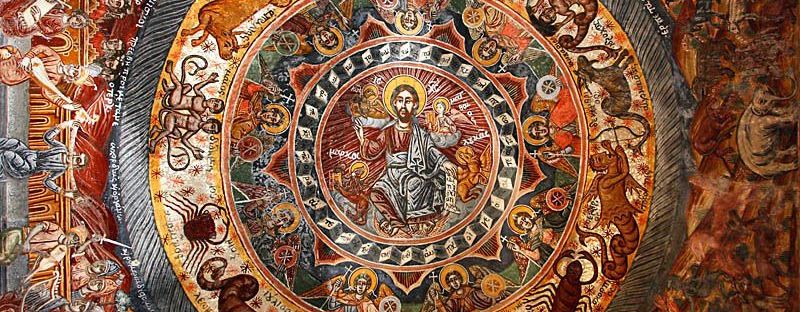
The featured image is a fresco from the Dekoulou Monastery in Greece, a community of the Greek Orthodox Church.
When the stars give you spoilers: why I love horary astrology

I’m often asked by folks—my ever-patient husband among them—why I favor horary astrology over the practice of something more well-known like natal astrology. My reasons aren’t overly complicated, but to get there I’d like to mention the difference between modalities of astrology.

Think about intelligence for a minute. The psychologist Howard Gardner delineated a theory of multiple intelligences in his 1983 book, Frames of Mind: The Theory of Multiple Intelligences. In short, Gardner proposed that the bigger concept of intelligence was better conceived of as subsisting in eight specific modalities, to include such things as verbal-linguistic intelligence (what you use when speaking or writing), logical-mathematical intelligence (what you use when solving logical or arithmetical problems), or intrapersonal intelligence (what you access when you are reflecting on your own interior emotional and cognitive life).

Gardner’s theory supposes that there’s not one overarching construction of intelligence, but rather, different people have different strengths and weaknesses in terms of the facility they have with each of these modalities.

So, by way of parallel, we can talk about astrology is an alternative means of knowing that has different modalities. If astrology is an intelligence, a language of symbolically meaningful correlations that we can utilize to tell stories about the way our lives shake out, then I would suggest that we can look at horary and natal astrology as being two different “modalities” of astrology that have a lot of overlap but necessarily deal with different things. The same set of rules that governs natal astrology also governs horary, more or less (especially if you’re a traditional astrologer), but they have wildly different applications.

So why do I prefer this particular modality of astrology to natal—especially since I also practice natal astrology?

One: horary astrology is results-driven. Either the horary astrologer gets the judgment right, or they don’t. At the end of the day, what drives a person to seek out the assistance of an astrologer is a specific precipitating event that has driven them to a crisis. And I think “crisis” is the right word here, because the Greek word from which we get our word “crisis” means “judgment,” which is what a horary consultation endeavors to do. We get the chart of the crisis (in the form of a question) and judge what will become of it.

Two: horary astrology is a powerful intervention tool. Because of the nature of some of the questions that horary astrologers encounter in their practice, it is often bringing us face to face with the challenging realities of people’s individual emotional, relational, vocational, and financial crises (or otherwise). The astrologer, then, has the sacred responsibility to treat the client’s question or concern with the patience and unconditional positive regard such a situation may demand. The astrologer then has the opportunity to speak directly into the client’s crisis, using the wisdom of the chart.

In my practice I’ve found that the very process of working with a client to massage a question into something that is clear and answerable with a horary consultation is illuminating both for the astrologer and for the client, who may have some unspoken challenges or matters which they are not addressing in the question but are critical for understanding how to move forward from the consultation space; these matters make themselves readily apparent in the chart of the question.

Three: horary astrology is concise and accessible.Dr. Lee Lehman, one of the biggest names in the traditional astrology world and one of my mentors by way of the STA, said something in an interview with Chris Brennan on the Astrology Podcast that has stayed with me for quite some time: “We have our entire lives to work out our natal charts.” Natal consultations are hard because we really are speaking about an entire lifetime of subjective and objective experiences and trying to make sense of the story that is underpinning all of them, which, if we’re not focused in how we’re approaching the natal chart, can cause us to become lost in a forest of subplots and details that don’t further the client’s understanding of their life station.

Meanwhile, a horary judgment is zeroed in on one specific issue or concern, and it’s not something that we need to spend the rest of our lives puzzling about it. As well, despite the complex nature of the rules that govern the practice of horary astrology, a story can be told clearly and concisely to the point that the practitioner need not make recourse to any astrological terminology.

A joiner to this: the best horary charts have strong connections to the querent’s natal chart for sure, and I have seen this come to bear in my own life even as recently as this week.

Four: horary astrology is rules-driven and rooted in tradition. The whole practice of horary astrology works because of the tight rules that govern the interpretation of horary charts which have been handed down from the ancient near east through medieval Europe and ultimately, through the rediscovery of William Lilly by Olivia Barclay and her successors in the traditional astrological revival of the late 1980s and following.

The rules of horary follow a clear, logical order, and because of that, they are straightforward to learn and use systematically to all manner of charts. There are a lot of rules, though, so there’s a little bit of a barrier to entry for folks who haven’t exercised their memorization chops in a while, but all the same, this art can be learned and taught effectively precisely because of the clarity of the rules.

I especially love it because all of the symbolism in the chart comes out of following these rules; for example, Mars and Venus coming to a conjunction in Scorpio is going to tell a vastly different story than Mars and Venus coming to a conjunction in Libra. The best practitioners are those whose attention to the rules are joined to intuition in a way that supports the clear and precise interpretation of the chart.

Five: my personal experience has validated the power of horary. I put this one towards the bottom of the list because I was already deeply attracted to and invested in my study of horary by the time I had any remarkable experience of it in my own life. It wasn’t until I was wrapping up my studies in the practitioner’s level course at the STA that I asked and judged a question for myself, a career matter that is still playing out in ways that are, frankly, uncanny (which I won’t get into here). The chart spoke concisely and directly to a decision I was making and, two months ahead of time, predicted a new and important collaborative partnership that would emerge in my day job that necessitated me remaining deeply rooted therein.

So, yeah, it works.

In sum, I love this art simply because when questions are asked with sincerity and openness to whatever it is the Divine has to say about the matter, it works, and it gives the kind of clear, direct, and constructive feedback to which modern life has grown accustomed. And, honestly, I think it’s for everyone; yes, the rules are arcane and require lengthy investment of time and energy to learn and deploy well, but the number of astrologers who have the knack for this is growing and the art is becoming more available to people who otherwise wouldn’t know that they have recourse to the heavens.

Do you have a pressing, personal question that you would like to address with horary astrology? Send me an email today!

Cover photo by Steven Hille

Les Histoires Beoulviennes, or, How I Came To Astrology

As I’ve said elsewhere, I’ve always been a bit fascinated by spooky things, to use my friend Sonja’s terminology. At the same time, I’m a study in contradictions, to be sure; I am an openly gay man, a mental health professional, and an advocate for science—and at the same time, I’m a devout member of one of the traditional Abrahamic faiths (my day job, in fact!) and I’m not convinced that empiricism is the only legitimate means of knowing.

So in view of all that, what’s one more weird thing to add to my CV?

My first exposure to astrology was when my sisters brought home scented pens with their sun signs on them; I recognized the symbols from the horoscope section of the newspaper, which, in the Potomac News, were printed immediately opposite the first page of the comics in the Sunday edition and right above the crossword. I would glance through them every now and then but I could never square the vague Virgo aphorisms with the vicissitudes of my chubby nine-year-old life experience. But I knew I was a Virgo.

When my sisters brought the pens home, they told me, “if Mom asks why we chose these, just say we liked how they smelled.” So I went along with it—and I knew that there was something exciting, something to explore underneath these glyphs and colors and scents.

My mom (a Capricorn sun and a preacher’s wife) was an Anti-Harry Potter Mom™ who started each day with two cups of strong black coffee and an hour of Joyce Meyer while walking on the treadmill in our family basement. She forbad me from reading Harry Potter until she relented as I entered the eighth grade; little did she know that I had snuck home and read a copy of Chamber of Secrets which I had bought at a used book sale at my middle school. But I already knew about astrology at this point, because I also happened to be—and remain—a colossal Final Fantasy nerd.

Final_Fantasy_Tactics_LogoIn 1998, Squaresoft (now Square Enix) released a game called Final Fantasy Tactics, a turn-based strategy RPG set in a reimagining of late-medieval Europe called Ivalice. The hero, Ramza Beoulve, is by all accounts “on the wrong side of history,” as his journey to save his sister brings him into the darkest secrets of the powers that be—viz, the aristocracy, who is in bed with the Church (of Ajora Glabados, not of Jesus Christ, though the whole Glabados-as-a-critique-of-Christianity thing is another iteration of an overdone trope).


Unknown

Ramza Beoulve is a tiny precious angel baby

One of the primary game mechanics in this masterpiece of a game was a system of sun signs. I thought at first they were just flavor; you could, in fact, pick Ramza’s sun sign during the first moments of a new game. But I discovered as I played the game that sun signs mattered: on my first play through I had a magic-using character named Rivaldi, who was a Capricorn. I found that he managed to pull off spells with greater accuracy and power when targeted against units who were either Tauruses or Virgos; yet, his attempts to hit Aries or Libra units met with difficulty, and it was downright impossible to hit a Cancer unit if it was male—but spells cast on Cancer female units would, for some reason, always connect.

Fft-dycedarg-beoulve

Ramza’s eldest half-brother, Dycedarg Beoulve, though he ends up being a Bad Guy, could 500% still get it.

I had discovered synastry! Admittedly, it was an extremely stripped down version: spells and abilities worked well against units whose sun sign was a trine from the user, and faltered against squares and oppositions. Sextiles and conjunctions didn’t do anything, alas. There were sub-mechanics involving a character’s level of bravery and piety as well; a pious Aquarius would have better chances not only of blasting a unit off a parapet with Meteor, they’d also have a better shot at using Rhetoric to talk that enemy off the ledge and bring them to your team. The possibilities were endless.

As you progress through the game you encounter the Big Bads pulling the strings behind the scenes, a collection of twelve eldritch horrors in the image of each of the signs (and a thirteenth, if you do enough side quests). It happens that the final boss of the game is a Virgo—not just Virgo, but the Virgo, a twisted archetype of the original holy maiden whose constellation lent its name to the sign with which we’re familiar. Imagine what a relief for a Good Boy Like ME to find that Virgos could be bad guys, too. Needless to say I used my burgeoning astrological wisdom to sent Rivaldi into this fight in order to work some high-octane magicks, like a good Virgo.

Final Fantasy Tactics and its sister games, the remainder of the Tactics franchise and the main series title Final Fantasy XII, have continued to keep (to varying extents) their astrological symbolism as plot points of varying importance throughout the development of each game. All thirteen signs (gag me!) shaped environments, bosses, summons, and mythology for each of Ivalice’s incarnations and the stories that have woven together over these many years have given rise to one of the richest universes in Square Enix’s oeuvre.

FFT_Serpentarius

I REBUKE IT IN THE NAME-o’-JESUS

At the same time, the discerning reader should note that the inclusion of Ophiuchus in the tropical zodiac of Ivalician mythos is a side effect of Ophiuchus’ popularity in Japanese pop-astrology. There’s an Ophiuchus emoji, for Glabados’ sake! But somehow I managed to avoid becoming a sidereal astrologer in the midst of all of this. Perhaps we should leave working with Ophiuchus as an optional side-quest.

I carried the Ivalician zodiac with me for some time, always checking my sun sign column every now and then, even during my deepest plunge into the caverns of evangelicalism. When I went through a major life transition in 2012, leaving most of the comforts of evangelical surety that I had used as a ruse for hiding my insecurities in the process, I came back to astrology for lack of any other reason than “I need some kind of direction right now,” and I started reading Susan Miller’s Astrology Zone monthlies. What ho—there are more objects in the sky to note than just the sun on my birthday? And they move!? And I shouldn’t be reading the Virgo article as my main source!!?

I was hooked. To discover that Jupiter hanging out in my eighth house would correspond with growing up, to find that the progressed new moon lined up with my coming out—it worked. And let’s not even begin talking about Mercury transits during Mercury profection years.

It all worked. A little too well.

I read bit by bit, article by article, about different Venus and Mars placements; I pried for possible partners’ birth data so I could at least find out where their own Venus and Mars were; I got really excited when it worked easily and when I ran into difficulties I had to dig in a little bit. But I kept at it. And now I’m here.

I’m not a perfect astrologer, and indeed I’m still learning the ins and outs of the art—but nevertheless, I’m trying to hone my skills as best as I can. (Maybe you can help me practice.)

Astrology has made my experience of creation deeper and richer in ways that I never would have imagined at the outset; it’s not just about figuring out your chances for fame and fortune and sex—it’s about seeing more clearly the will of the fundamental goodness that drives the universe.